Blue Marlin Fishing: The Ultimate Ocean Challenge 2026
Understanding Blue Marlin Behavior and Migration Patterns
Seasonal Migrations in 2026 of Blue Marlin
Blue Marlin travel thousands of miles following warm ocean currents like the Gulf Stream and Pacific Equatorial currents. Tracking sea surface temperature shifts is key to locating active feeding zones this season.
Blue Marlin Seasonal Migration
Blue Marlin are apex open-ocean predators that undertake massive annual transoceanic migrations driven primarily by water temperature shifts, seasonal current movements, and baitfish availability. In 2026, changing global weather cycles and localized upwelling shifts have altered traditional migration corridors, making advanced tracking more essential than ever. Anglers targeting giant Blue Marlin must closely observe major oceanic highways such as the Gulf Stream in the Atlantic, the Humboldt Current along South America, and the Equatorial Currents across the expansive Pacific Ocean.
During early spring, these magnificent apex predators begin migrating away from equatorial wintering zones toward temperate high-seas areas where baitfish schools concentrate around underwater structure, seamounts, and ocean ridges. By mid-summer, high concentrations of large adult marlin establish reliable feeding territories along continental shelf edges and steep drop-offs where deep, nutrient-rich water upwells into warm surface layers.
Understanding these precise seasonal transit routes allows offshore captains to position their vessels directly within high-density migratory lanes well before the fish arrive in numbers, significantly increasing hookup rates during prime seasonal windows. Furthermore, satellite telemetry and real-time tagging data continue to reveal that mature females often lead these migratory surges, traveling along sharp temperature drops where hunting efficiency is highest. By carefully mapping these annual routes, offshore charter fleets can maximize their fishing efforts and ensure high-probability encounters throughout the peak 2026 season.
Water Temperature and Current Dependencies for Fishing Blue Marlin
Water temperature plays a decisive role in governing Blue Marlin activity, metabolic rate, and hunting behavior. These pelagic titans prefer surface water temperatures ranging strictly between 75°F and 82°F (24°C to 28°C), with the most explosive surface strikes routinely occurring along sharp thermal breaks where warm blue offshore water intersects cooler, green nutrient-dense coastal water. These distinct temperature boundaries act as physical barriers that concentrate micro-plankton, drawing massive schools of skipjack tuna, bonito, squid, and mahi-mahi directly into narrow feeding corridors.
Advanced oceanographic satellite mapping and real-time sea-surface temperature (SST) imaging allow modern captains to pinpoint these thermal edges with extreme precision before leaving the harbor. When trolling near sharp thermal fronts, it is critical to present lures right along the warmer side of the temperature boundary, as Blue Marlin frequently cruise the warm blue water while peering into the cooler nutrient boundary to ambush disoriented baitfish.
Furthermore, major ocean currents create downwelling zones and convergence lines that trap floating Sargassum weed, oceanic debris, and offshore flotsam, forming vibrant ecosystems that attract hungry pelagic predators from hundreds of miles around. Understanding how currents compress bait against submarine canyons gives anglers a distinct advantage, allowing them to focus their trolling patterns precisely where thermal walls force pelagic gamefish into predictable feeding behavior patterns
Essential Tackle and Gear Requirements for Catching Blue Marlin
Heavy-Duty Offshore. Reels and Rods be redy for fight Blue Marlin
Tackling a powerful Blue Marlin requires heavy-duty big game tackle engineered to withstand immense kinetic pressure and prolonged friction. Standard offshore equipment relies heavily on 80lb to 130lb class custom-built fishing rods featuring solid carbon fiber or composite blanks, heavy-duty roller guides, and machined aluminum curved butts. The curved butt design is crucial because it lowers the leverage point when locked into a fighting chair or stand-up harness, giving the angler maximum pulling power without putting excessive strain on the lower back.
Paired with these specialized rods are ultra-durable dual-speed lever drag reels capable of holding at least 1,000 to 1,500 yards of high-test line while delivering up to 40 to 60 pounds of drag pressure at strike setting. Dual-speed gear ratios allow the angler to quickly switch from a high-speed retrieve (used to pick up slack when the marlin charges toward the boat) to a low-speed power gear (used to pump up a stubborn fish locked in a deep dive).
Every component—from the heavy-duty reel seats to the machined aluminum harness lugs—must be inspected meticulously before stepping offshore, as a single mechanical weak point will inevitably fail under the sheer force of a grander-class fish. Investing in top-tier anodized aluminum reels with sealed drag stacks prevents catastrophic saltwater corrosion, ensuring smooth drag dispersion during furious 40-knot runs.
Selecting the Ideal Braided and Monofilament Line for Blue Marlin hing speed
Spooling an offshore big game reel correctly requires a strategic combination of modern braided line and traditional monofilament top-shot to achieve the ultimate balance between line capacity, strength, and shock absorption. The foundation of the reel should always consist of heavy-duty hollow-core braided line (typically 100lb to 130lb test), which fills two-thirds of the spool capacity due to its ultra-thin diameter relative to breaking strength.
Braid provides exceptional line capacity, allowing anglers to survive long, high-speed directional runs without fear of being spooled. Above the braided backing, anglers splice 200 to 300 yards of high-visibility, premium monofilament top-shot using seamless mono-to-braid hollow-core connections. Monofilament line is indispensable because it offers necessary stretch (around 15% to 20%) under extreme load, acting as a natural shock absorber when a 500-pound marlin leaps repeatedly out of the water or makes violent, high-speed head shakes.
Additionally, a heavy monofilament or fluorocarbon wind-on leader ranging from 200lb to 400lb test is attached to the main top-shot, providing essential abrasion resistance against the marlin’s razor-sharp bill and rough skin during the final, grueling stages of the fight beside the boat. Selecting line colors like high-vis yellow or blue allows deck hands to track line trajectory instantly during erratic surface jumps.
Artificial Lures vs. Live Bait Techniques for best opcione of catching Blue Marlin
Top Performing Trolling Lures for Blue Marlin
Slant-face, plunger, and jet-head lures are primary choices. Match lure sizes to local baitfish and maintain a high-action bubble trail behind the boat.
Artificial trolling lures remain the most versatile and efficient search tools for locating scattered Blue Marlin across vast expanses of open ocean. Modern big game lures feature engineered head designs including slant-face pushers, plunger styles, concave chuggers, and streamlined jet heads, each designed to swim with distinct swimming motions and hydro-dynamic bubble trails.
Slant-face lures create aggressive, erratic popping actions on the surface before diving deep to leave a dense trail of air bubbles, making them ideal for long-outrigger positions. Jet-head lures, constructed with weight holes drilled through the metal or resin head, remain submerged at higher trolling speeds, cutting through heavy chop to entice deep-running fish.
Color selection plays a vital role based on sunlight penetration, water clarity, and local prey species; popular patterns include high-contrast combinations like blue and silver (mimicking flying fish and juvenile tuna), green and yellow (mimicking mahi-mahi), and luminescent pink-white setups.
Matching lure dimensions and head profiles to the prevailing local baitfish size ensures that cruising marlin view the artificial spread as a natural, easy-to-catch meal opportunity. Furthermore, positioning weighted lures closer to the vessel creates violent surface cavitation that mimics panicked baitfish trying to escape larger ocean predators.
Rigging Live Bait for Blue Marlin, Maximum Action
Bridling live tuna or bonito through the eye sockets or snout with circle hooks allows natural swimming movement while maximizing solid hook-up ratios.
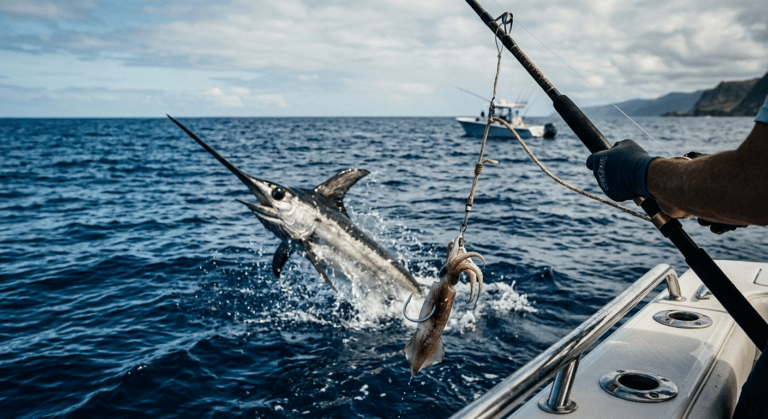
When marlin are localized around specific structures such as underwater seamounts, fish aggregating devices (FADs), or deep ocean platform structures, live baiting often produces higher strike ratios than artificial trolling lures. Preferred live bait species include small yellowfin tuna, skipjack, bonito, rainbow runner, and large bullet mackerel.
To present live bait naturally without impairing its movement, expert mates utilize specialized bridling techniques using heavy Dacron loop lines and large inline circle hooks (ranging from 10/0 to 12/0). The bridle loop is passed through the tough nasal cartilage or forward eye socket area of the baitfish using a bait needle, then secured snugly onto the bend of the circle hook. This keeps the hook completely exposed and free from obstruction, ensuring high-ratio jaw corner hookups while allowing the live bait to swim naturally at slow trolling or drifting speeds (between 2 to 4 knots).
Maintaining a steady water circulation around the live bait during transit and carefully deploying it into clean, undisturbed water away from boat wake turbulence guarantees a lively, attractive presentation that triggers immediate strikes from nearby predators. Mates must handle live bait with wet cotton gloves to preserve protective slime coatings, preventing early exhaustion once deployed behind the vessel.
Advanced Trolling Patterns and Spreading Tactics be redy for Blue Marlin
Setting Up the Outriggers and Downriggers for Blue Marlin
Deploy a staggered 4 to 5-lure pattern using long and short outriggers alongside flat lines. Use downriggers to presentation lures below the surface wake.
To maximize coverage across the water column and prevent disastrous line tangles during sharp boat turns, captains run precise multi-lure spreads using outriggers and downriggers. A standard big game trolling setup utilizes a 5-to-7 lure pattern positioned in a staggered V-formation behind the vessel. Long and short outriggers spread the outer lures far into clean water outside the prop wash, giving artificial lures maximum room to swim without interference.
The long outrigger lure is typically positioned furthest back (the “shotgun” or long-center position), swimming up to 100 yards behind the boat to target cautious, trailing marlin. Short outriggers and flat-line clips present larger, more aggressive lures closer to the stern wake, where water turbulence attracts curious predators looking for disoriented prey.
To complement the surface spread, heavy-duty downriggers or deep-planer boards are deployed off the stern corners, sinking live or dead baits 30 to 80 feet below the surface wake. This multi-depth configuration ensures that both surface-feeding fish and deeper-dwelling marlin cruising along the thermocline encounter a tempting target. Fine-tuning outrigger line tension clips allows lures to pop cleanly upon impact without prematurely releasing under normal hydrodynamic resistance.
Optimizing Trolling Speed and Lure Distance for Blue Marlin
Maintain trolling speeds between 7.5 and 9.5 knots. Position lures on the face of the vessel’s stern wake waves to maximize popping action.
Achieving the optimal trolling speed and fine-tuning lure positioning relative to the boat’s stern wake waves is critical for maintaining maximum lure action. Trolling speeds for artificial lures generally range from 7.5 to 9.5 knots, depending on sea conditions, wind direction, and hull characteristics. At these speeds, properly weighted lures should breathe regularly—popping up to collect air on the face of a wake wave, plunging back underwater while spitting a thick trail of bubbles, and swimming smoothly without flying out of the water or spinning uncontrollably. Mates must constantly adjust line lengths to ensure every lure sits cleanly on the forward face of the vessel’s stern waves.
The stern wake creates distinct pressure waves, and placing lures on the downward slope of these crests provides natural hydrodynamic propulsion, creating a lifelike action that entices strikes. When trolling into heavy head seas, boat speeds must be reduced slightly to prevent lures from washing out; conversely, when running downwind with trailing seas, throttle adjustments are necessary to prevent lures from stalling or losing their bubble trails. Keeping precise GPS speeds ensures lures maintain consistent action regardless of changing surface current directions.
Reading Blue Marlin Ocean Conditions and Sea Structures
Identifying Thermal Edges and FADs for Blue Marlin
Use satellite sea-surface temperature (SST) maps to locate distinct thermal fronts. Fish Around Floating Anchor Devices (FADs) that concentrate bait schools.
Successfully finding Blue Marlin in the vast, featureless ocean requires a deep understanding of marine topography, thermal boundaries, and man-made aggregating structures. Fish Aggregating Devices (FADs)—whether surface buoys anchored in thousands of feet of water or deep ocean oil platforms—create self-contained marine ecosystems.
Microscopic organisms colonize the underwater cables and structures, attracting small baitfish, which in turn draw large pelagics like tuna and mahi-mahi, eventually concentrating top-tier predators like giant marlin. In addition to physical structures, natural thermal edges created by intersecting water currents are prime hunting grounds.
Using high-resolution satellite sea-surface temperature (SST) maps, experienced anglers locate narrow thermal fronts where water temperatures drop or rise sharply over short distances. These thermal walls trap nutrients and disorient baitfish, creating ideal ambush zones. When fishing near FADs or ocean thermal boundaries, captains repeatedly run trolling passes along the upcurrent side of the structure or temperature wall, where live bait concentrations are highest and marlin actively cruise in search of prey. Marking structural drop-offs on multi-frequency echo sounders ensures lures stay directly within active predator transit lanes.
Locating Seabird Activity and Bait Ball Formations for Blue Marlin
Scan the horizon for diving frigate birds and shearwaters. Aggressive bird activity indicates pelagic predators forcing bait balls to the surface.
Skilled offshore anglers constantly scan the horizon using high-powered stabilized binoculars to locate subtle signs of life, with seabird activity serving as one of the most reliable visual indicators of pelagic activity below.
Frigate birds, shearwaters, and petrels possess exceptional eyesight and routinely follow underwater hunting packs of marlin and tuna from high above the surface. When birds begin circling tightly, hovering low over the water, or making sudden diving plummets into the sea, it signals that large predatory fish have forced a school of baitfish to the surface, creating a dense “bait ball.”
Beneath these swirling bait balls, giant Blue Marlin slash aggressively through the concentrated prey with their bills, stunning baitfish before circling back to swallow them. Approaching seabird activity requires careful boat handling: captains should never drive the boat directly through the center of a bait ball, as this disrupts the natural feeding pattern and causes the bait to scatter deep. Instead, circle the outer perimeter of the bird activity, trailing artificial lures or live bait along the edges where large marlin patrol the outer edges of the commotion. Monitoring bird behavior provides immediate real-time updates on depth changes and predator aggression shifts below.
Hooking and Setting the Drag Effectively
Lever Drag Adjustments During Strikes for Blue Marlin
Keep drags set at strike pressure (roughly one-third of line breaking strength). Avoid increasing drag during the initial high-speed run to prevent line snaps.
Properly setting and adjusting the lever drag system during an explosive Blue Marlin strike is a critical skill that separates experienced offshore anglers from novices. When a massive marlin crashes a trolling lure, the initial response must be controlled and methodical. Modern big game lever drag reels should always be preset to a precise “strike” setting—typically calibrated at one-third of the main line’s breaking strength (around 25 to 30 pounds of drag pressure for an 80lb to 130lb setup). When the fish strikes, resist the immediate urge to push the lever drag forward into the “full” position.
Pushing the drag lever too high during the initial, high-speed run increases heat and friction exponentially along the drag washers, which often causes line snaps or tears the hook cleanly out of the fish’s mouth. Allow the marlin to take its first blistering 200-yard run against the steady, smooth resistance of the strike drag setting. As the line peels off the spool, the overall diameter of the line on the spool decreases, effectively increasing the drag friction naturally due to mechanical physics. Therefore, pushing the drag lever higher while the fish is running at top speed is extremely risky. Once the initial run settles down, the boat is maneuvered into position, and the angler is fully braced in the harness or fighting chair, the lever drag can be gradually bumped up to apply maximum pressure during short, controlled pumping phases.
Solidifying the Hookset in Heavy Jaws of the Blue Marlin
Allow the fish to eat before applying heavy pressure. When using circle hooks, maintain boat speed and steady tension rather than jerking the rod.
Securing a firm, reliable hookset in the dense, cartilage-filled jaw of a Blue Marlin requires technique, patience, and a deep understanding of terminal tackle mechanics. The bony mouth structure of a billfish makes traditional upward rod jerking completely ineffective, especially when hundreds of yards of line are deployed behind the boat. When using modern inline circle hooks, the entire hookset process is engineered to happen automatically through smooth line tension. When the marlin engulfs the bait, the captain maintains steady forward vessel momentum while the angler allows the line to pull tight against the drag.
As the fish turns away to submerge, the circle hook slides naturally out of the stomach cavity, travels along the jawline, and rolls smoothly into the corner of the mouth, setting firmly into the tough jaw tissue. Jerking the rod tip abruptly during this critical phase simply pulls the circle hook out of the fish’s mouth before it has time to rotate into position. If fishing with traditional J-hooks on artificial trolling spreads, the hookset is achieved by maintaining high boat speed for an extra five to ten seconds after the initial strike, allowing the force of the moving vessel to drive the heavy gauge hook points past their barbs before reducing throttle speed.
Mastering the Stand-Up Fighting Technique for Blue Marlin
Harness Alignment and Weight Distribution
Connect a kidney harness to the reel lugs and drop your hip height to utilize lower body leverage rather than relying solely on upper body arm strength.
Mastering the stand-up fighting technique requires strict adherence to biomechanical alignment, proper harness positioning, and effective body weight distribution. Attempting to fight a 500-pound pelagic predator using raw upper-body arm strength leads to rapid physical exhaustion within minutes. To maximize leverage and efficiency, the angler must wear a heavy-duty kidney or bucket harness properly paired with an ergonomic stand-up gimbal belt. The harness straps connect securely to the top lugs of the dual-speed lever drag reel using durable stainless steel carabiners.
The crucial technical adjustment involves lowering the harness point so it sits across the upper glutes and lower hips rather than the lower lumbar back. By dropping your center of gravity and bending your knees slightly, you can lock your body into an athletic stance, using your lower body quadriceps, hamstrings, and glutes to absorb the immense tension generated by the fish. Instead of pulling up with your arms, lean your entire body weight backward into the harness, allowing your core leverage to naturally lift the rod tip. This ergonomic technique diverts stress away from the spine and biceps, enabling anglers to maintain intense, continuous pressure during grueling multi-hour stand-up battles.
Pumping and Reeling Without Fatigue
Smoothly lift the rod tip using body weight, then reel down swiftly to gain line. Maintain continuous rhythm to exhaust the fish efficiently.
Once a heavy marlin slows down after its initial acrobatic runs, the battle transitions into a rhythmic phase of short-pumping and rapid line retrieval. The objective during this phase is to continuously gain line without introducing dangerous slack or over-fatiguing the angler. The short-pumping rhythm consists of two distinct, synchronized movements: the smooth lift and the swift drop-and-reel. To initiate a pump, sit back slightly into your stand-up harness or lean back in the fighting chair, using your legs to smoothly raise the rod tip from a horizontal angle up to roughly 45 degrees.
Never lift the rod past 60 degrees, as high-sticking places extreme parabolic pressure on the tip section, risking a catastrophic rod blank explosion under heavy load. Once the rod tip reaches its peak, quickly lean your upper body forward while rapidly reeling down to gather every inch of gained line before the rod reaches the horizontal starting position again. Maintaining continuous, unbroken line tension throughout this process is imperative; dropping the rod tip faster than you can crank the reel handle creates temporary line slack, giving the marlin an immediate opportunity to throw the hook or break line momentum.
Fighting Big Blue Marlin from the Fighting Chair
Proper Footrest and Chair Positioning
Adjust the footrest length so your legs remain slightly bent under load. Keep the chair pointing directly toward the line entry point into the water at all times.
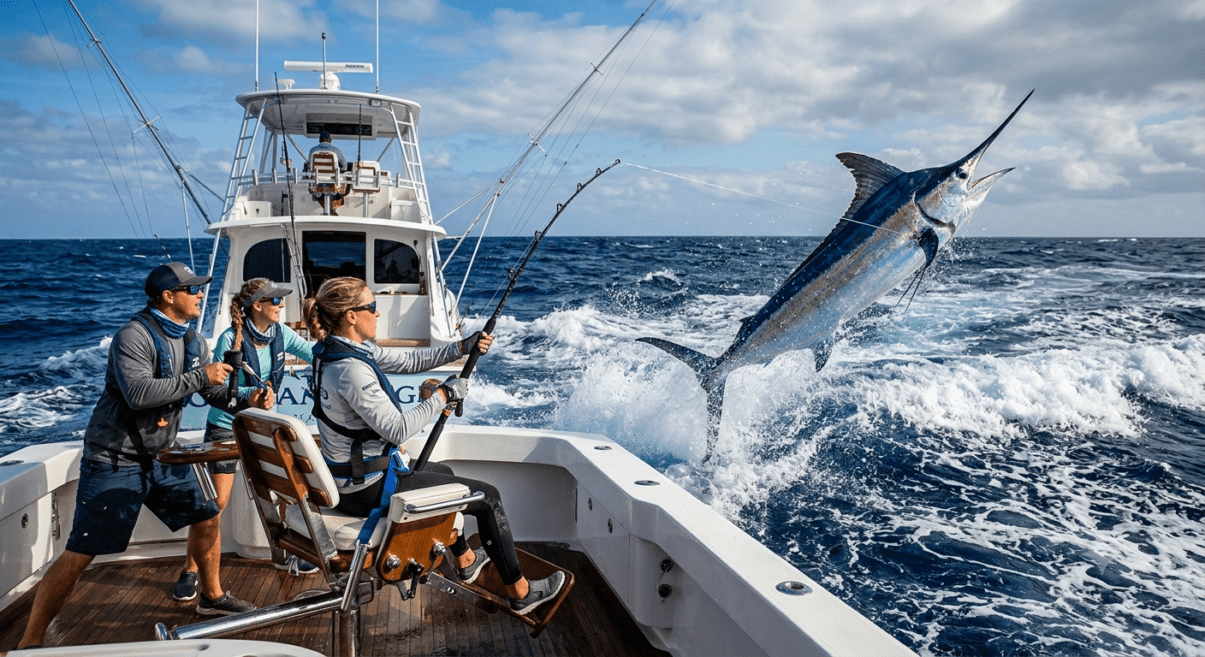
When fighting giant Blue Marlin exceeding 500 pounds, a professionally rigged fighting chair provides unmatched mechanical leverage, safety, and stability. Correct fighting chair adjustment begins long before the first line is set in the outriggers. The footrest length must be precisely adjusted for the angler’s leg length: when seated fully back against the chair’s backrest with feet firmly planted on the footrest bar, the knees should retain a slight, comfortable bend under load. This slight bend acts as a hydraulic suspension, allowing the angler to drive through their heels to exert massive pulling pressure through the harness.
The deck hand or mate plays a vital role during the battle by operating the chair’s swivel mechanism. The chair must be kept pointing directly toward the entry angle of the fishing line into the water at all times. If the fish makes a sudden, lateral directional run and the chair is not pivoted in sync with the line angle, extreme lateral side-torque is applied across the fishing rod guides and reel spool, drastically increasing line friction and threatening structural equipment failure.
Boat Handling Strategies During the Battle with Blue Marlin
Captains must back down or maneuver aggressively on the fish to assist the angler in recovering line before the marlin dives deep into cold water layers.
Successfully landing a giant pelagic fish is an equal partnership between the angler on the rod and the captain at the vessel’s throttles. Once the marlin settles after its initial surface acrobatics, the captain must aggressively maneuver the boat to aid line recovery and prevent the fish from diving deep into cold, low-oxygen water layers. In big game marlin fishing, backing down on the fish—reversing the vessel at high speed through the open sea—is a standard strategy to regain hundreds of yards of line quickly.
The captain must carefully balance reverse speed with sea conditions to prevent large waves from washing over the transom and flooding the cockpit. If the marlin sounds and locks into a deep, stubborn vertical dive, the captain can shift from backing down to “circling” or “planing” the fish. By executing tight, continuous wide turns around the hooked marlin, the vessel changes the angle of drag tension on the fish’s head, forcing it to tilt upward and breaking its swimming rhythm, which allows the angler to pump the heavy weight back up toward the surface.
Leadering and Boat-Side Management
Safe Leadering Hand Operations
The mate should wrap heavy leader material around gloved hands using proper hand-over-hand turns, ready to dump wraps if the fish makes a sudden plunge.
The leadering phase is arguably the most hazardous portion of big game offshore fishing, occurring when the wind-on leader reaches the rod tip and the deck hand manually takes control of the heavy monofilament or wire line. The mate must wear thick, reinforced leather gloves to protect hands from friction burns and deep cuts caused by line tension.
When taking a wrap on the leader, the mate uses a precise hand-over-hand technique, laying the heavy 300lb to 400lb line flat across the palm before making an internal wrap around the gloved hand. Crucially, the leader must never be wrapped around the wrist, thumb, or fingers, as a sudden jump or dive from a panicked marlin can instantly drag a mate overboard or cause severe traumatic injury.
The mate must maintain a flexible, balanced stance on the deck, ready to immediately “dump” or release the line wraps if the marlin makes an unexpected, violent head shake or plunges beneath the vessel’s hull. Clear, calm vocal communication between the leadering mate, the captain on the bridge, and the angler on the rod ensures everyone reacts instantly to sudden changes in fish behavior alongside the gunwale.
Controlling the Blue Marlin Near the Gunwale
Keep the marlin moving forward alongside the hull to keep water flowing over its gills, ensuring control before applying bill-gripping techniques.
Once the leadering mate brings the Blue Marlin directly beside the boat’s gunwale, the boat crew must execute precise control measures to secure the fish safely without harming the crew or unnecessarily injuring the specimen. The captain keeps the vessel idling smoothly forward in gear; keeping forward water movement over the marlin’s gills ensures a steady supply of oxygen, keeping the fish calm and reducing thrashing against the fiberglass hull.
Once the fish is positioned flat alongside the hull, an experienced crew member uses heavily gloved hands to take a firm, two-handed grip on the base of the marlin’s rough, sandpaper-like bill. Controlling the bill neutralizes the fish’s primary defense weapon and prevents dangerous head whips that can shatter deck gear or injure crew members. If the marlin is intended for tagged release, the crew keeps the fish partially submerged in the water, avoiding pulling the full body weight over the gunwale. Maintaining a firm grip while the boat cruises slowly at two knots helps stabilize the fish, allowing secondary crew members to safely inspect hook placement, attach scientific ID tags, and prepare for hook removal procedures.
Catch Blue Marlin and Release Best Practices
Reviving the Marlin Alongside the Vessel
Tow the marlin slowly at idle speed while supporting the lower jaw until the fish regains full muscular tone and swims away strongly under its own power.
Ensuring maximum post-release survival rates for Blue Marlin requires a dedicated, thorough revival process before fully detaching the fish from the vessel. A long, exhausting fight causes heavy lactic acid accumulation in the fish’s muscular system, leaving it severely oxygen-depleted and vulnerable to predators like oceanic white-tip sharks if released prematurely.
To properly revive the marlin, the captain keeps the boat moving forward at a slow, steady idle speed (approximately 2 to 3 knots). While the vessel moves ahead, a crew member supports the fish alongside the gunwale, keeping the bill supported and maintaining the head under the surface facing directly into the oncoming water flow.
This forward motion forces oxygen-rich water smoothly through the open mouth and across the gill filaments, rapidly clearing accumulated lactic acid and restoring muscular vitality. The revival process should continue until the marlin demonstrates clear signs of recovery—indicated by vibrant color changes along its cobalt bars, active eye tracking, firm tail pulses, and strong jaw clamping pressure against the mate’s gloved hand. Once these vital signs return, the bill is released, and the marlin swims strongly back down into the ocean depths.
Safe Hook Removal Techniquesfor Blue Marlin
Use long-handled de-hookers to remove hooks safely. If deep-hooked, cut the leader line as close to the hook eye as possible to minimize internal trauma.
Mates utilize specialized long-handled, heavy-duty de-hooking tools, which slide down the leader line, lock onto the bend of the hook, and allow the mate to apply reverse leverage to pop the hook point out cleanly without placing hands near the thrashing mouth. However, if the marlin ingested the bait deep into its esophagus or stomach cavity (a deep-hook situation), attempting to forcibly extract or tear the hook out will cause fatal internal hemorrhaging.
In these deep-hook scenarios, international conservation protocols dictate cutting the heavy leader line as close to the hook eye as physically possible using specialized wire or monofilament cutters. Modern non-offset steel hooks left inside the fish will naturally degrade over time in saltwater, allowing the marlin to survive and feed without permanent structural damage.
Safely removing terminal tackle from a billfish is essential for both crew safety and marine conservation standards. Once the fish is controlled alongside the vessel and fully revived, the crew assesses the precise position of the hook. If the fish was caught using inline circle hooks, the hook is typically anchored neatly in the tough corner of the jaw, allowing for clean removal.
Top Global Destinations for Blue Marlin in 2026
Blue Marlin The Pacific Hotspots: Hawaii and Costa Rica
Kona, Hawaii offers calm waters and deep drop-offs minutes from shore, while Costa Rica provides steady action along offshore FAD networks.
The Pacific Ocean remains a powerhouse destination for world-class Blue Marlin encounters in 2026, with Hawaii and Costa Rica leading the global offshore scene. Kona, Hawaii, offers ideal big game conditions thanks to its unique volcanic topography. Steep underwater drop-offs drop into thousands of feet of calm, lee-side ocean water just minutes outside the harbor mouth. This allows charter fleets to present lures to giant pelagics within miles of the coastline. Further south along the Central American coastline, Costa Rica has solidified its status as a premier live-baiting paradise.
Operating out of Los Sueños or Golfito, modern sportfishing boats access extensive offshore networks of anchored Fish Aggregating Devices (FADs) located 40 to 100 miles out in the Pacific. These floating structures hold massive concentrations of live bait like bonito and juvenile yellowfin, creating high-density feeding hubs where anglers routinely achieve multiple marlin raises per day. Whether trolling heavy lures through Kona’s deep volcanic trenches or slow-baiting live tuna around Costa Rica’s offshore FADs, these Pacific hotspots deliver consistent action for both seasoned big game captains and novice billfish enthusiasts.
Atlantic Giants of Blue Marlin : Azores and Cape Verde
The Atlantic archipelagos of Cape Verde and the Azores remain premier targets for anglers seeking grander-class Blue Marlin exceeding 1,000 pounds.
For big game anglers seeking the ultimate prize—a “grander” Blue Marlin weighing over 1,000 pounds—the Atlantic archipelagos of Cape Verde and the Azores represent the absolute peak of offshore sportfishing. Situated in the central Atlantic currents, the island chain of Cape Verde features rough, wind-swept channels where nutrient-rich ocean upwellings feed massive schools of oceanic prey. Between April and July, giant female marlin concentrate here to feed before spawning, resulting in high hookup ratios on heavy 130lb tackle.
Further north in the Atlantic ocean lies the Azores, an archipelago renowned for producing giant pelagics during the late summer months. Here, deep volcanic drop-offs and oceanic seamounts attract massive solitary marlin that migrate along the Gulf Stream. Fishing these Atlantic hotspots requires heavy-duty tackle, experienced captains who can handle rough open-ocean swells, and precise lure presentations. Fighting a grander-class fish in these deep offshore waters tests physical endurance to the absolute limit, making Cape Verde and the Azores legendary destinations for serious anglers targeting record-breaking marlin.
Electronics and Sonar Technology Innovations
3D Sonar Mapping for Pelagic Predator Blur Marlin
Modern omnidirectional sonar units allow captains to mark individual marlin up to several hundred feet away from the vessel in real-time.
The modern era of big game marlin fishing relies heavily on cutting-edge marine electronics, with advanced 3D omnidirectional sonar transforming how captains target pelagics. Unlike traditional down-looking fish finders that only scan the water column directly beneath the boat hull, modern high-frequency sonar units send out multi-beam acoustic pulses in a 360-degree radius around the vessel. This technology allows captains to detect individual Blue Marlin hunting bait schools several hundred feet away in real time.
The high-resolution 3D mapping software displays detailed target tracking on bridge monitors, showing the precise depth, distance, speed, and directional heading of the fish. Upon marking a deep-dwelling marlin on the screen, the captain can immediately adjust the vessel’s course to steer the trolling spread directly over the fish’s path. Furthermore, 3D sonar aids in mapping complex underwater structures, seamount pinnacles, and thermocline layers where bait gathers. Incorporating omnidirectional marine electronics eliminates guesswork on the water, enabling charter fleets to find active gamefish far faster than traditional visual search tactics allow.
Thermal Imaging and Water Temp Sensors
Ultra-precise digital temperature gauges help detect micro-degree water changes that trigger feeding frenzies along oceanic drop-offs.
Detecting subtle environmental shifts in oceanic conditions is essential for locating active feeding grounds, making digital water temperature sensors and night thermal imaging critical bridge tools. Blue Marlin are highly sensitive to sea surface temperature changes, often hunting along micro-degree thermal fronts where warm offshore current boundaries intersect cooler coastal waters. High-precision digital temperature gauges mounted on the vessel’s hull provide real-time surface temperature readouts accurate to a fraction of a degree.
Marking these subtle temperature changes helps captains stay positioned on the warm side of a ocean front where predators cruise. To complement thermal sensors, modern sportfishing boats utilize forward-looking infrared (FLIR) thermal imaging cameras. These high-definition thermal systems detect surface temperature variances visually, allowing crews to identify subtle thermal edges, floating flotsam debris, Sargassum weed mats, and schooling baitfish under low-light conditions or early morning hours before sunrise. Utilizing temperature sensing technology allows offshore crews to narrow down vast expanses of open water into high-probability hunting lanes, maximizing trolling efficiency throughout the trip.
Weather Planning and Safety at Sea
Navigating Offshore Weather Shifts
Monitor doppler radar and offshore weather broadcasts closely. Blue Marlin grounds are often far out, requiring reliable weather windows.
Safely targeting Blue Marlin requires meticulous weather planning and continuous monitoring, as prime marlin grounds are situated dozens of miles out in open ocean environments. Offshore weather conditions can deteriorate rapidly, turning calm seas into hazardous high-wave environments within hours. Prior to clearing the harbor, captains must consult Doppler radar, satellite wind models, and marine weather forecasts to verify stable sea conditions. While on the water, bridge electronics continuously monitor live satellite weather radar to track squalls, heavy rain fronts, and sudden wind direction shifts.
Understanding local oceanographic patterns is equally critical; strong wind-against-current conditions can generate steep, dangerous seas that strain boat equipment and make trolling spreads inefficient. If a heavy offshore weather system approaches, the captain must make early, decisive adjustments—either altering the trolling path toward sheltered waters or aborting the trip completely. Maintaining constant vigilance over changing barometric pressure and surface wave heights ensures that offshore crews can pursue big game pelagics aggressively while keeping the vessel and crew completely safe from sudden marine weather hazards.
Essential Marine Safety Gear Checklists for Blue Marlin
Ensure satellite EPIRBs, life rafts, personal locator beacons, and satellite communication devices are fully operational before clearing the harbor.
Venturing miles into open ocean waters in search of giant gamefish demands strict compliance with marine safety protocols and comprehensive emergency equipment checklists. Every big game sportfishing vessel must be equipped with fully certified, up-to-date safety gear designed for extreme offshore conditions. Essential safety items include a Coast Guard-approved hydrostatic release life raft, personal locator beacons (PLBs), high-buoyancy life jackets equipped with emergency strobe lights, and a Category 1 automatic satellite Emergency Position Indicating Radio Beacon (EPIRB). The EPIRB should be mounted cleanly on the vessel’s superstructure to ensure immediate automatic deployment if submerged.
Additionally, long-range communication tools such as fixed satellite phones and dual VHF radios ensure continuous contact with coast guard stations and nearby offshore fleets even when out of cell service range. Before leaving the dock, the captain must conduct a thorough safety briefing with the crew and anglers, verifying the operational status of automatic bilge pumps, fire suppression systems, and heavy-duty offshore medical trauma kits. Prioritizing marine safety ensures peace of mind when fighting powerful fish in remote waters
Teaser Strategies to Draw Strikes for fight vith Blue Marlin
Dredge Rigging and Color Selection for visibility of the Blue Marlin
Deploy heavy umbrella dredges rigged with artificial or natural mullet. Holographic and natural color schemes attract curious fish from deep water.
To draw curious Blue Marlin up from deep water column layers into your surface trolling spread, artificial umbrella dredges are unmatched surface attractors. A dredge consists of a heavy-duty stainless steel frame carrying dozens of artificial or preserved natural baits, mimicking a tightly packed bait ball swimming beneath the vessel’s prop wash.
Weighting the front hub with heavy lead sinkers keeps the dredge submerged 5 to 15 feet below the surface wake. Natural baits like preserved mullet or ballyhoo offer lifelike texture and scent, while artificial rubber mud minnows, soft squids, and holographic fish strips provide durability under high-speed trolling conditions.
Color selection plays a vital role depending on sunlight penetration and water clarity: high-contrast patterns like chartreuse, dark blue, and luminescent pink-white excel on bright sunny days, while metallic silver and holographic foil patterns reflect maximum light through deep blue water. Deploying heavy dredges off deep downriggers creates continuous underwater flash and water displacement, convincing deep-riding marlin that a major feeding opportunity is happening directly behind the vessel transom.
Daisy Chains and Noise Makers
Run surface teasers like bird-and-squid daisy chains to generate commotion and acoustic vibrations that mimic a feeding frenzy behind the boat.
Creating visual commotion and acoustic vibration behind the boat transom is essential for attracting pelagic gamefish, making surface teasers like daisy chains and bird noise makers indispensable tools. A classic daisy chain consists of multiple soft plastic squids or resin teasers inline-rigged along a heavy monofilament leader, terminating with a weighted trailing bait to keep the setup running straight. When trolled through the surface wake, the daisy chain skips aggressively across the water, mimicking a fleeing school of squid or juvenile baitfish.
To amplify surface commotion, anglers pair daisy chains with acoustic “birds”—molded wooden or plastic teasers equipped with wings or cupped faces that splash vigorously and generate low-frequency underwater vibrations. These sound waves mimic the hydro-acoustic noise generated by feeding pelagic packs, drawing curious marlin from hundreds of yards away to inspect the surface spread. Mates run these hookless teasers off short outriggers or flat lines, slowly pulling them away as a marlin approaches to force the fish onto a trailing hook-armed lure.
Understanding Blue Marlin Biology and Diet
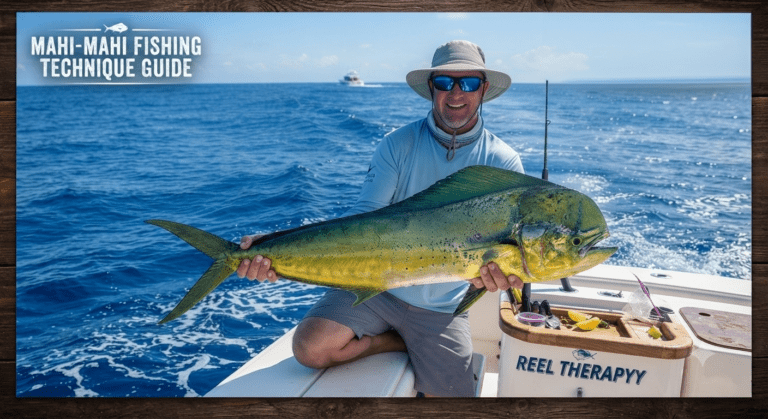
Primary Prey: Squid, Tuna, and Mahi-Mahi
Blue Marlin are apex open-ocean hunters, feeding heavily on juvenile yellowfin, skipjack tuna, squid, and mahi-mahi to sustain their fast metabolism.
Blue Marlin are high-metabolism apex hunters that require substantial daily caloric intake to sustain their massive muscular growth and active lifestyle. Their primary diet consists of energy-dense pelagic species found across warm open ocean layers, including juvenile yellowfin tuna, skipjack, frigate mackerel, bonito, mahi-mahi, and large oceanic squid. Fast-swimming pelagics like skipjack tuna provide high protein levels, making them a preferred target when marlin are hunting along deep structure edges or oceanic seamounts.
Additionally, large ocean squid species form a major part of their diet, particularly during low-light hours or deep thermocline dives where squid migrate upward from deep waters. Understanding local bait concentrations dictates lure selection for the day: when marlin are feeding on small mahi-mahi around floating Sargassum weed mats, trolling green and yellow lures yields higher strike rates. Conversely, when skipjack tuna are present, presenting darker blue, silver, or purple patterns mimics natural prey profiles. Matching lure size and swimming action to the active prey species ensures maximum hookup success on the water. if you wont to discover more abaut mahi-mahi fish reed hire Link allso we have tips and tricks for fishing tuna.
Vision and Lateral Line Dynamics of the Blue Marlin
Large eyes optimized for low-light conditions paired with highly sensitive lateral lines allow them to detect subtle water displacements made by fleeing prey.
Blue Marlin possess highly specialized sensory systems engineered to locate and ambush prey across vast, dim ocean environments. Their massive eyes are structurally adapted for high visual clarity in low-light conditions, featuring specialized retinal cells that maximize contrast detection in deep blue water. This exceptional eyesight allows marlin to spot subtle movements, shimmering scales, and lure silhouettes from long distances, even when hunting beneath heavy surface chop or during twilight hours.
Complementing their vision is a highly sensitive lateral line system running along the sides of their body. The lateral line consists of fluid-filled sensory canals capable of detecting minute pressure changes, low-frequency sound vibrations, and hydro-dynamic turbulence generated by fleeing baitfish or churning boat propellers. This combined sensory system allows marlin to track fast-moving targets accurately before launching high-speed strikes. Understanding how billfish utilize sight and vibration highlights the importance of running noisy surface teasers and high-contrast lure colors that stand out cleanly against deep ocean water backgrounds.
Charter Boat vs. Private Boat Tactics
Communicating with Professional Captains
Establish goals before leaving the dock. Communicate preferred techniques, whether focusing on heavy tackle giant hunting or lighter tackle volume catches.
Clear and open communication between the angling group and the professional charter captain is essential for executing a successful offshore trip. Before clearing the dock, sit down with the captain and crew to outline primary expectations, preferred target species, and desired fishing styles. Whether your goal is targeting a grander-class Blue Marlin on heavy 130lb tackle or achieving high numbers of billfish raises using lighter stand-up gear, informing the captain allows them to tailor the day’s strategy accordingly.
Furthermore, discuss physical capabilities and experience levels honestly so the crew can adjust harness setups, safety procedures, and rod placement on the deck. During the trip, trust the captain’s expertise when analyzing changing weather patterns, sea states, and fishing locations. Professional charter captains possess decades of localized knowledge regarding seasonal current movements, bait behavior, and ocean drop-offs. Maintaining positive, ongoing communication throughout the charter ensures a seamless workflow on the cockpit deck, allowing the crew and anglers to react as a cohesive unit when a giant marlin crashes the spread.
Customizing Private Boat Setups
Optimize deck layout, clear obstruction areas, and ensure outrigger release clips are calibrated precisely for heavy offshore trolling loads.
Optimizing a private sportfishing vessel for heavy big game trolling requires precise deck organization, proper rigging maintenance, and customized hardware configurations. Clear the aft cockpit deck of all non-essential equipment, safety hazards, and loose gear to ensure free movement for the deck crew during chaotic multi-line strikes. Heavy outriggers must be calibrated with high-tension release clips capable of holding heavy trolling lures at high speeds without premature release.
Ensure that all rod holders, fighting chair mounts, and gimbal belts are securely bolted into the vessel’s sub-frame to withstand massive pulling forces. Additionally, position live-bait wells and heavy-duty kill boxes in easily accessible deck areas to keep walkways clear. Installing high-output raw water washdown hoses near the transom allows crew members to clean slick blood and slime off the teak deck instantly, preventing slipping hazards during the battle. Tailoring your private boat setup specifically for big game operations maximizes safety, speeds up gear deployment, and ensures your team operates with the same crisp efficiency seen on elite tournament sportfishing vessels.
Circle Hooks vs. J-Hooks Compliance
Reducing Mortality Rates with Circle Hooks
Circle hooks consistently catch in the corner of the jaw, drastically reducing gut-hooking incidents and increasing survival rates for released fish.
The widespread adoption of inline circle hooks in big game marlin fisheries has revolutionized billfish conservation, drastically reducing post-release mortality rates compared to traditional J-hooks. Circle hooks feature a unique inward-pointing hook tip design that prevents the hook from catching inside the fish’s throat or stomach cavity. When a Blue Marlin swallows a live or dead bait, the angler maintains steady line tension as the fish turns away.
As the line tightens, the circle hook slides safely out of the digestive tract and rolls neatly into the corner of the jaw, anchoring securely into tough tissue without causing internal organ damage or severe hemorrhaging. This mechanical design eliminates gut-hooking incidents, ensuring that released fish retain their muscular integrity and health upon return to the ocean.
Many major offshore tournaments and international fisheries regulations now mandate the exclusive use of non-offset circle hooks when natural live or dead baits are deployed, playing a vital role in sustaining healthy global billfish populations for future generations.
Tournament Fishing Strategies and Rules
Time Management on the Water
Prioritize prime tide shifts and lunar windows during tournament hours. Maintain disciplined line rotation to keep fresh baits in the water.
Maximizing fishing productivity during limited tournament hours or day charters requires disciplined time management and strategic planning on the water. Prioritize prime fishing windows by aligning your trolling schedules with major tide shifts, moon phases, and optimal water temperature windows when pelagic activity peaks. Avoid spending valuable trolling hours in dead, low-probability water; if a location shows zero bird activity, flat water temperatures, and no bait on the echo sounder, make the call early to relocate to productive structure edges or ocean drop-offs.
Maintain a disciplined bait and lure rotation throughout the day. Regularly inspect terminal tackle for chafing, weed accumulation, or damaged skirts, swapping out dulled baits to keep fresh, highly enticing presentations in the wake at all times. Assign specific deck duties to each crew member—designating who clears lines, who handles the leader, and who operates the fighting chair—so the team executes fast, synchronized actions when a strike occurs, minimizing lost time and maximizing hookup opportunities.
Scoring Systems and Tagging Rules
Familiarize yourself with strict tournament rules regarding video verification, line class limits, tag placement standards, and reporting protocols.
Competing in international big game marlin tournaments demands strict adherence to sanctioned rules, accurate catch documentation, and precise reporting protocols. Modern tournament scoring systems heavily favor release points using scientific tagging programs over weighing landed fish, promoting marine conservation while maintaining high competitive standards. Anglers must familiarize themselves with specific tournament rules regarding authorized line class limits, leader length maximums, and hook configurations before setting lines.
When a marlin is brought alongside the vessel, the crew must deploy an official scientific dart tag into the high dorsal muscle of the fish using an applicator pole, taking care to avoid critical organ structures. To verify the catch for scoring, tournament officials usually require continuous, unedited video footage clearly showing the angler fighting the fish, the tag being placed cleanly near the dorsal fin, and the leader being held by the mate before the fish is safely released. Reviewing video verification guidelines and tag reporting standards prevents unnecessary point disqualifications during official tournament scoring.
Night Fishing for Oceanic Blue Marlin Predator
Luminous Lures and Light Sticks for Blue Marlin
Utilize glow-in-the-dark lure heads and attach green or UV light sticks above live bait rigs to attract fish during low-light hours.
Targeting pelagic predators during low-light conditions, early morning hours, or night sessions requires specialized visual attractors to pull fish out of the deep ocean column. Blue Marlin possess highly developed eyes optimized for contrast detection, making luminous, glow-in-the-dark lure heads and artificial chemical light sticks extremely effective. Glowing lure heads absorb ambient light and emit a soft luminescent trail underwater, mimicking bioluminescent ocean organisms like deep-sea squid and jellyfish.
When live baiting or slow-trolling at night, attaching high-visibility green, UV, or blue chemical light sticks onto the main leader line roughly 6 to 10 feet above the bait provides a bright visual focal point that draws curious gamefish toward the hook setup. Furthermore, modern LED water-activated lights integrated directly into trolling skirts generate subtle, pulsating light frequencies that cut through dark, murky water. Utilizing luminescent tackle strategies allows offshore anglers to extend their productive fishing hours well into the night, tapping into deep-water feeding frenzies that traditional visual lures cannot trigger.
Navigational Precautions at Night
Maintain extra lookout vigilance, utilize radar systems, and reduce boat speeds to prevent collisions with floating debris or ocean structures.
Operating an offshore sportfishing boat in deep ocean waters at night presents unique navigational challenges that require extreme vigilance, reduced vessel speeds, and advanced electronic monitoring. Navigating in total darkness eliminates visual cues, making high-resolution marine radar units indispensable for detecting unlit vessels, ocean buoys, and floating flotsam debris.
Captains should run dual radar displays—one set to long range for tracking approaching squalls and vessel traffic, and the second set to short range for identifying close-range surface hazards. Complementing radar with forward-looking thermal infrared (FLIR) cameras allows bridge operators to spot semi-submerged shipping containers, wooden logs, and sleeping marine life directly in the vessel’s path.
Furthermore, dim all interior bridge displays and cockpit lights to preserve the crew’s night vision, utilizing soft red LED deck lighting for safe foot placement during gear management. Maintaining lower vessel speeds while running at night drastically reduces collision risks, ensuring that the boat and crew arrive safely at the targeted offshore grounds.
Physical Conditioning for Anglers
Core Strength and Endurance Drills
Focus on rotational core stability, deadlifts, and back endurance training to withstand hours of intense pressure during stand-up battles.
Enduring grueling, multi-hour stand-up battles against giant Blue Marlin requires high levels of physical conditioning, core stability, and functional endurance. The rotational forces and intense vertical tension exerted by a heavy fish place extreme pressure on the lower back, core abdominal muscles, quadriceps, and hamstrings. Off-water physical training should prioritize core stability exercises such as planks, rotational cable woodchoppers, and deadlifts, which build a solid lumbar foundation able to absorb high torque loads without injury.
Additionally, incorporating functional leg exercises like heavy squats and lunges strengthens the lower body, allowing anglers to maintain an athletic bent-knee stance in the fighting harness for extended periods. Cardiorespiratory endurance training—including rowing machines, swimming, and high-intensity interval training (HIIT)—prepares the cardiovascular system for continuous physical exertion under intense tropical heat.
Conditioning your body prior to offshore trips prevents muscle fatigue, reduces back strain, and provides the physical stamina necessary to pump giant gamefish to the surface safely
Hydration and Sun Protection Standards
Wear UPF 50+ performance apparel, stay hydrated with electrolyte solutions, and maintain proper physical stamina under extreme tropical heat.
Prolonged exposure to harsh tropical sun rays, intense water glare, and high temperatures poses significant physical risks for offshore anglers, making strict hydration and sun protection protocols vital for safety and performance. Dehydration and heat exhaustion severely impair reaction times, physical strength, and mental focus on the deck.
Anglers must consume electrolyte-enriched fluids continuously throughout the day rather than relying solely on plain water or caffeinated beverages. To guard against skin damage and heat stress, wear high-performance UPF 50+ breathable long-sleeve performance shirts, wide-brimmed hats or neck gaiters, and high-quality polarized sunglasses with UV400 protection to block intense surface glare.
Reapply broad-spectrum water-resistant sunscreen regularly across exposed skin areas, particularly the face, neck, and hands. Maintaining proper hydration levels and thermal protection ensures that anglers retain their energy, physical stamina, and sharp focus throughout long, demanding days on open ocean waters.
Underground Forum Secrets and Angler Tips for Blue Marlin
Secret Hook Sharpening and Geometry Tricks
Veteran offshore anglers rarely use hooks straight out of the package. On private fishing forums, experienced mates emphasize the triangular point file technique. Filing the outer edges of a heavy-gauge hook into a three-sided dagger point drastically improves penetration through the hard, bony jaws of a giant marlin. Additionally, angling the hook point slightly inward prevents the point from skittering off tough jaw cartilage during the initial strike setup.
The Stealth Lure Rigging Modificationfor Blue Marlin
A widely discussed secret among tournament crews is eliminating visible crimps and heavy stainless steel wire connectors directly in front of the lure head. By sliding a stiff rubber sleeve or clear heat-shrink tubing over the main leader crimp, you eliminate unwanted water cavitation and bubble trails ahead of the lure’s face. This keeps the lure moving with a natural action and prevents sharp-eyed billfish from short-striking at the hardware instead of the hook point.
Reading Subtle Water Color Transitions
While satellite SST charts give macro-level data, forum insiders rely on observing micro-color edges directly on the water. The boundary between deep cobalt blue water and slightly greener rich water creates a invisible wall where microorganisms gather. Marlin cruise right along the blue side of this edge, striking baitfish that wander across the color line. Trolling parallel to these micro-edges rather than crossing them perpendicularly leads to significantly higher strike rates.
Engine Noise Tuning and Frequency Manipulation
Many seasoned charter captains discuss the pitch and vibration of vessel diesel engines. Marlin are known to be attracted to specific low-frequency hums produced by twin-diesel setups operating at 1,800 to 2,100 RPM. Experienced captains often adjust their propeller pitch to match harmonics that mimic schooling baitfish acoustics, effectively turning the boat’s hull into the ultimate primary teaser.
Unconventional Live Bait for Blue Marlin ,Presentation Hacks
An insider trick for live baiting involves adding a small, flexible silicone skirt directly above the bridle of a live tuna. This added skirt reduces water drag against the baitfish’s head, allowing it to swim longer without tiring, while simultaneously adding a splash of contrasting color (such as pink or pink-white) that triggers aggressive predatory strikes from cruising marlin.
Ultimate Ocean-Style Blue Marlin Steak Recipe
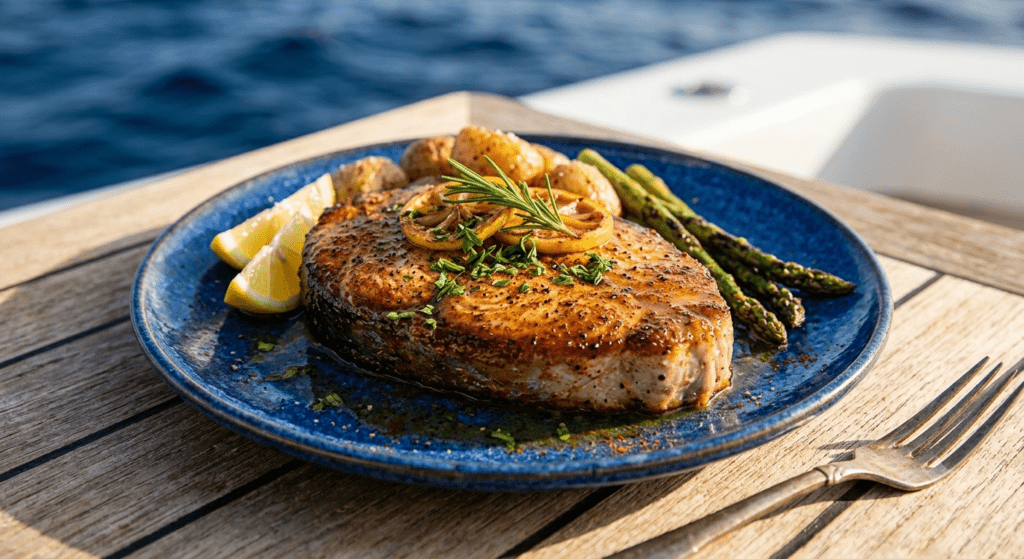
Ingredients and Preparation Requirements
Prepare fresh marlin steaks (1.5 inches thick), olive oil, minced garlic, sea salt, freshly cracked black pepper, smoked paprika, fresh rosemary, lemon juice, and unsalted butter. Ensure the steaks are patted completely dry with paper towels prior to seasoning to facilitate proper searing.
Step 1: Marinating for Optimal Flavor and Moisture
In a ceramic dish, combine 3 tablespoons of extra virgin olive oil, 2 cloves of crushed garlic, 1 tablespoon of fresh lemon juice, half a teaspoon of smoked paprika, salt, and pepper. Coat the marlin steaks evenly and allow them to marinate at room temperature for no longer than 20 to 30 minutes to retain structural firmness.
Step 2: High-Heat Sear and Searing Process
Heat a heavy cast-iron skillet over high heat until it begins to smoke lightly. Add a tablespoon of high-smoke-point oil (such as avocado oil). Carefully lay the marlin steaks into the pan. Sear for 3 to 4 minutes on the first side without moving them to develop a golden-brown crust. Flip smoothly and sear for an additional 2 to 3 minutes until medium-rare to medium (internal temperature reaching 130°F/54°C).
Step 3: Crafting the Citrus Herb Butter Sauce
Reduce heat to low, add 2 tablespoons of unsalted butter, a sprig of fresh rosemary, and a squeeze of fresh lemon juice directly into the skillet. Spoon the melted, foaming herb butter continuously over the tops of the marlin steaks for the final minute of cooking to baste the fish thoroughly.
Step 4: Plating and Serving Recommendations
Remove the marlin steaks from the heat and let them rest on a warm plate for 5 minutes. Serve garnished with fresh parsley, lemon wedges, and accompanied by roasted sea-salt potatoes or grilled asparagus for an authentic ocean-side meal.