Sturgeon Fishing Globally: From Western Commercials to Wild River Giants 2026

Sturgeon Fishing Guide: Everything You Need to Know
Introduction and Biological Background of the Sturgeon
These prehistoric giants represent some of the most extraordinary creatures inhabiting our planet’s freshwater and marine environments. Having survived for hundreds of millions of years, their basic biological layout has remained remarkably unchanged since the era of the dinosaurs. Featuring armored bony plates along their flanks instead of traditional scales, elongated snouts, and powerful heterocercal tails, they possess an appearance that instantly distinguishes them from modern bony species. Their presence in a aquatic system usually indicates a mature, nutrient-rich ecosystem capable of supporting large benthic predators over extended lifespans. Understanding their ancient biological traits, migratory patterns, and environmental requirements is crucial for any angler who aims to pursue them responsibly and effectively on commercial or wild waters.
Origins and Native Habitats of the Sturgeon
Tracing the evolutionary history of these ancient bottom-dwellers leads back to the Late Cretaceous period, making them true living fossils of the aquatic world. Originating in the vast northern river networks that drained prehistoric continental landmasses, they successfully adapted to an array of post-glacial environments across Eurasia and North America. Their distribution historically covered massive river basins such as the Danube, the Volga, the Mississippi, and the Fraser, alongside adjacent inner seas like the Black, Caspian, and Baltic basins. Deep river channels provided stable thermal conditions and constant water flow, which allowed these slow-growing creatures to establish massive multi-generational populations. Over vast geological epochs, their fundamental physiology proved exceptionally resilient against shifting climates, provided that uninterrupted river pathways remained open for seasonal movements.
Glacial River Systems for Sturgeon
Glacial meltwater rivers provided the primary cradle for the radiation and survival of these primitive fish species across northern continents. The sheer volume of cold, oxygen-saturated water flowing through broad floodplains created expansive gravel beds and deep pool complexes. These underwater geological features were vital for adult survival during harsh winters and offered ideal conditions for egg deposition during high-water spring events. Deep river trenches acted as thermal refuges where adult specimens could congregate away from high-velocity surface currents, conserving vital energy reserves between feeding excursions. Furthermore, the constant turnover of substrate caused by seasonal glacial flooding continually refreshed the gravel banks, keeping them clear of fine silt that could otherwise suffocate delicate eggs. The sheer scale of these ancient river systems allowed large individuals to roam across hundreds of miles in search of abundant benthic food deposits, establishing migratory routes that persisted for thousands of years until modern human engineering altered the natural flow of major continental rivers.
Estuarine and Coastal Waters for Sturgeon
Transitional estuarine zones and shallow coastal margins serve as vital feeding and nursery grounds for many anadromous members of this ancient family. As young fish mature and journey down from their freshwater birthplaces, the brackish waters of river deltas provide a rich buffet of invertebrate life while allowing their physiological systems to adapt gradually to higher salinity levels. These nutrient-dense coastal margins support rapid physical development, offering vast beds of crustaceans, marine worms, and small bottom fish that are far more abundant than upper-river food sources. Adult specimens often spend several consecutive years roaming ocean estuaries and shallow bays, accumulating massive fatty reserves necessary to fuel their grueling return migrations upstream. However, access to undisturbed estuarine environments has become increasingly restricted in modern times due to coastal industrialization, harbor dredging, and altered salinity balances caused by upstream water diversion. Protecting these brackish transitional spaces remains just as critical for long-term species survival as maintaining pristine gravel spawning beds deep within inland river networks.
Feeding Habits and Diets of the Sturgeon
Feeding predominantly on or near the lakebed or river bottom, these powerful creatures employ a highly specialized sensory apparatus to locate prey in low-visibility environments. Lacking functional teeth in adulthood, their feeding process relies entirely on vacuum-like protrusible mouths capable of extending downward to scoop up soft organic matter and bottom-dwelling organisms. Located just ahead of the mouth on the underside of the snout are four sensitive fleshy barbels packed with chemoreceptors. These appendages continuously sweep the substrate, detecting minute chemical traces and subtle electrical impulses emitted by hidden invertebrates buried beneath sand or silt. Once food is located, a powerful suction action draws the prey along with sediment directly into the mouth cavity, where edible items are separated from inorganic debris before being swallowed whole.
Bottom Foraging Behavior for Sturgeon
The daily foraging routine of these heavy bottom-feeders is a methodical, highly efficient search pattern tailored to sweeping vast areas of the substrate. Moving slowly against the prevailing current with their snouts held close to the riverbed, they keep their barbels in constant physical contact with the bottom. This continuous chemical and tactile scanning allows them to pinpoint pockets of food even in pitch-black depths or heavily clouded water columns where vision is completely useless. When the sensory barbels cross over an area rich in buried worms, larvae, or small shellfish, the fish halts its forward movement and drops its protrusible mouth directly onto the target zone. A sudden expansion of the buccal cavity creates an immense vacuum force that extracts the prey from surrounding mud or gravel instantly. Any silt or fine sand ingested during this aggressive suction process is routinely expelled through the gill slits, leaving only dense, nutritious food items inside the digestive tract. Anglers targeting these fish must ensure that their bait presentations sit completely flat and motionless on the bottom, as any floating or drifting line can disrupt this delicate sensory sweeping process and cause the fish to veer away before taking the hook.
Seasonal Dietary Shifts for Sturgeon fish
Throughout the calendar year, the nutritional demands and dietary choices of these large aquatic predators undergo dramatic transformations governed by water temperature and reproductive cycles. During late autumn and winter, as water temperatures plunge toward freezing levels, their metabolic rate drops significantly, resulting in prolonged periods of lethargy where feeding activity drops to a bare minimum. As ice melts and spring water temperatures rise past key biological thresholds, an intense surge in feeding activity occurs to replenish depleted body mass and prepare mature individuals for potential spawning runs. During this high-energy spring phase, they prioritize food sources rich in proteins and complex lipids, actively seeking out spawning aggregations of smaller fish, dense worm beds, or dying organic matter washed down by high spring flows. By mid-summer, when water temperatures peak and dissolved oxygen levels drop, feeding patterns shift primarily toward nocturnal windows when water conditions are cooler and aquatic invertebrates become more active along shallow shelves. Recognizing these seasonal behavioral shifts enables dedicated anglers to adapt their bait selection, switching from heavy oil-based baits in high-energy periods to highly digestible, scent-focused offerings when water temperatures cool down.
Legal Status and Regulations for the Sturgeon
Global populations of these ancient fish have suffered catastrophic declines over the past century due to overharvesting, illegal poaching, pollution, and the construction of migration-blocking dams. Consequently, legal frameworks governing interactions with these species are among the most restrictive in the entire world of fisheries management. In natural wild river networks, total bans on commercial harvesting and sport targeting are widely enforced across multiple international jurisdictions to prevent total population collapse. Anglers operating in regions where wild remnant populations exist are bound by strict conservation laws that mandate instant release protocols and prohibit any intentional targeting with heavy bottom tackle. Conversely, the growth of heavily regulated private commercial fisheries has created a legal, controlled outlet for sport anglers seeking to experience the immense strength of these fish without endangering wild stocks.
Protected Waters and Strict Bans for the Sturgeon
In major river basins across Europe and North America, wild populations are classified under the highest tiers of international protection, including CITES listings and strict national endangered species acts. In rivers like the Danube, Tisa, and Volga, intentionally setting rigs to catch wild specimens is strictly illegal, carrying severe financial penalties and potential criminal prosecution. These complete legal bans are designed to protect the very small number of adult breeding individuals remaining in natural river channels, ensuring that natural spawning attempts proceed without human disturbance. In the event that an angler accidentally hooks one of these protected specimens while fishing for other bottom species, local regulations demand that the fish be handled entirely within the water, unhooked immediately using specialized tools, and guided safely back into the flow without ever lifting its body onto dry ground or boat decks. Educational campaigns run by conservation bodies continuously remind the angling community that the survival of wild lineage relies on zero human contact during delicate migration periods.
Permitted Commercial Venues for Sturgeon
To satisfy the recreational demand for targeting giant freshwater species without impacting fragile wild ecosystems, managed commercial fisheries operate under strict state-issued licenses. These private lakes and enclosed fishery complexes are stocked exclusively with farm-raised specimens legally sourced from accredited aquaculture facilities. Venue owners must enforce strict local rules designed to safeguard the physical health of their resident fish stocks. These regulations typically mandate the use of extra-heavy mainlines to prevent long, exhausting fights, large knotless landing nets, ultra-thick unhooking cradles, and completely barbless single hooks that minimize mouth damage during unhooking. Additionally, commercial fisheries often set strict daily limits on line pressure, prohibit the use of unapproved bait formulations or hazardous rig components, and enforce mandatory resting periods for fish after landing. By offering a strictly controlled environment, commercial waters provide sports enthusiasts with a safe, legal, and educational platform to appreciate these magnificent creatures while ensuring zero stress is added to wild river environments.
Value and Terminology of Sturgeon Caviar and Meat
The economic value associated with these prehistoric freshwater giants stems primarily from two highly prized commodities: their unfertilized salt-cured eggs, internationally renowned as caviar, and their firm, boneless culinary flesh. Historically considered a food reserved for royalty and elite banquets, caviar remains one of the most expensive and sought-after luxury food products in the global culinary market. Because females take anywhere from eight to over twenty years to reach sexual maturity and yield eggs, producing authentic caviar requires enormous long-term capital investment and meticulous aquaculture management. Additionally, the unique physical properties of their meat, which lacks floating pin bones and features a dense, steak-like muscular texture, have made it a prized protein source across eastern European and Asian culinary traditions for centuries. Modern international trade regulations strictly monitor all commercial distribution of these products through CITES certification frameworks to combat illegal poaching and guarantee that all legally sold roe and meat originate exclusively from certified sustainable aquaculture facilities.
Caviar Classification and Value for Sturgeon
The commercial classification and market evaluation of caviar depend heavily on the specific species from which the roe is harvested, as well as the size, color, firmness, and flavor profile of the individual eggs. Beluga roe, harvested from the largest species within this primitive family, commands the absolute highest price on the luxury market due to its immense grain size, soft texture, and buttery flavor profile. Osetra roe, derived from medium-sized species, offers a nutty aroma and varies in color from deep bronze to shimmering gold, making it exceptional popular among fine-dining connoisseurs. Sevruga roe features smaller, dark gray grains that pack a concentrated, intensely aromatic sea flavor. The process of curing these eggs requires incredible precision; master salt-curers apply the traditional “Malossol” technique, adding less than four percent pure salt to preserve the natural, delicate taste profile of the fresh roe without overpowering its subtle creamy nuances. Due to the strict international bans on wild harvesting, high-grade farm-raised caviar can cost thousands of dollars per kilogram, making it a high-stakes agricultural endeavor that demands pristine water quality, customized bio-secure diets, and advanced ultrasound monitoring to evaluate egg maturity before gentle extraction.
Culinary Characteristics of the Flesh Sturgeon
Unlike the soft, flaky flesh characteristic of most modern teleost freshwater fish, the meat of these ancient bottom-dwellers boasts a remarkably dense, boneless texture that closely resembles swordfish, monkfish, or tender veal. Supported entirely by a cartilaginous notochord rather than a hard bony skeleton, a dressed fillet yields solid, continuous portions completely free of delicate pin bones, making it exceptionally easy to carve and prepare in high-end restaurant kitchens. The flesh is naturally rich in essential omega-3 fatty acids, high-quality proteins, and vital minerals, providing a rich, satisfying mouthfeel that holds up exceptionally well to intense cooking methods such as grilling, smoking, roasting, and pan-searing. Historically, whole roasted fish were served as centerpiece dishes during imperial Russian and medieval European banquets, often glazed with aromatic herbs, white wine, and rich butter sauces. In contemporary cuisine, sustainable farm-raised fillets are prized for their ability to absorb complex dry rubs and liquid marinades without breaking apart or losing moisture on the grill. The high gelatin content within the cartilaginous framework also makes the head, fins, and trimmings ideal bases for rich, aromatic fish stocks and traditional soups like Russian Solyanka.
Primary Fishing Techniques for the Sturgeon
Heavy Feeder Tactics for Sturgeon
Targeting these immense bottom-dwelling creatures in large commercial lakes or swift-flowing river currents requires heavy feeder tactics engineered to maintain complete terminal rig stability under severe physical stress. Standard light-feeder gear is completely useless when dealing with fish that easily exceed fifty pounds; anglers must deploy heavy-duty feeder rods paired with oversized method feeders or heavy inline lead weights weighing anywhere from four to eight ounces. The primary goal of heavy feeder tactics is to deliver a dense, concentrated package of high-protein groundbait, crushed oil pellets, and chopped natural baits directly onto a precise section of the seabed. Once the heavy feeder settles onto the substrate, the breakdown of the groundbait creates an irresistible scent plume that drifts downstream or across the lakebed, guiding patrolling bottom-feeders directly toward the hookbait. To prevent the heavy rig from shifting or rolling in fast river currents, flatbed method feeders or textured inline leads are essential, as any dragging motion can snag underwater obstacles or cause suspicious fish to abort their feeding approach.
Static Ledgering Methods for Sturgeon
Static ledgering represents the most reliable, battle-tested methodology for enticing heavy bottom-feeders that rely primarily on olfactory cues to locate their meals along the lake or riverbed. This technique involves casting out a heavy, stationary terminal rig that anchors the bait firmly to a fixed point on the substrate, allowing long-lasting scent trails to wash over surrounding feeding lanes. A classic running lead setup or safety bolt clip is utilized to ensure that when a fish vacuums up the bait, it experiences minimal initial line resistance, allowing it to move away confidently while the hook shifts into position. Keeping the mainline completely pinned to the bottom using heavy backleads or sinkers is a vital element of successful static ledgering, as these large fish possess highly sensitive fins and scutes that easily detect taut lines cutting through the water column. When a patrolling specimen feels an unnatural line brushing against its body, it will instantly spook and evacuate the baited swim. By keeping terminal presentations completely static, pinned flat, and free of unnecessary movement, static ledgering maximizes solid hook holds in the tough tissue of the bottom lip.
Rod Selection Criteria for the Sturgeon
Power and Action Requirements for Sturgeon
Selecting the appropriate rod for targeting these freshwater titans requires a careful evaluation of power ratings and blank action to ensure full control during intense battles. Blank test curves rating between 3.5 lb and 5.0 lb are mandatory to generate the leverage required to cast heavy lead assemblies and control massive, high-torque fish in fast-flowing water. A rod with a progressive or parabolic action is far superior to an ultra-stiff fast-action rod, as the gentle parabolic bend acts as a massive shock absorber during sudden violent headshakes, powerful tail swipes, or sudden close-quarters lunges near the landing net. If a rod blank is too rigid, the immense force exerted by a heavy fish against a short line will pull the hook directly out of its mouth or snap heavy terminal hooklinks instantly. Furthermore, high-power rod blanks provide the structural backbone necessary to push large, heavy fish away from dangerous underwater snags, submerged timber, and sharp gravel ledges, ensuring that the angler maintains complete control throughout every phase of the fight without exhausting the fish to dangerous physical limits.
Length and Blank Construction for Sturgeon
The overall length and material composition of the rod blank play an influential role in casting performance, line control, and fighting leverage when pursuing large specimens. Rods measuring twelve to thirteen feet in length represent the ideal industry standard, offering the optimal balance between long-distance casting capability and comfortable handling along bankside swims. Modern blanks constructed from high-modulus carbon fiber reinforced with woven resin matrices deliver exceptional structural strength without adding excessive physical weight, allowing anglers to hold and maneuver heavy gear effortlessly. Extra length allows the angler to lift heavy mainlines high above near-shore currents, preventing river flow from dragging the terminal rig out of the baited zone. Additionally, heavy-duty stainless steel or silicon carbide (SiC) rod guides with double-leg frames are essential to withstand the intense friction and heat generated by thick monofilament or braided mainlines sliding through the guides during explosive runs. A long, well-constructed carbon blank absorbs punishing power bursts, protecting both the terminal tackle integrity and the physical welfare of the fish.
Reel Specifications for the Sturgeon
Drag System Performance
The performance and structural integrity of a reel’s drag mechanism are paramount when battling heavy, powerful fish capable of pulling hundreds of yards of line during unstoppable initial runs. A micro-adjustable front drag system featuring multi-disc carbon fiber washers provides the heat dissipation, smoothness, and immense stopping force needed to slow down powerful surges. Sticking or jerky drag washers are completely unacceptable; any sudden hesitation in line release under high tension will snap heavy leader lines or tear hooks out instantly. Anglers should look for reels that offer high maximum drag pressure ratings—ideally twenty-five pounds or higher—allowing precise micro-adjustments during the fight. When a fish makes a powerful run toward deep water or snags, the drag must yield line smoothly without sudden spikes in tension, while providing enough stopping power when the angler needs to turn the fish’s head back toward open water. Regular maintenance and keeping drag washers clean and dry ensure long-term reliability under severe load conditions.
Line Capacity and Spool Design for Sturgeon
Large-capacity “Big Pit” reels engineered for heavy specimen hunting are mandatory when setting up tackle for these long-distance bottom battles. These oversized reels feature deep, wide-diameter spools capable of holding at least 300 to 400 meters of thick, high-diameter monofilament or braided mainline. The large spool surface area drastically reduces line friction against the lip during long-distance casts, allowing heavy feeders and large lead weights to reach distant river channels or deep lake beds effortlessly. Furthermore, a long-stroke slow-oscillation spool winding system places line onto the spool in precise parallel wraps, preventing heavy line coils from bedding down under high drag tension during intense fights. A high line retrieval rate—ideally retrieving over one meter of line per full handle turn—allows the angler to reel in slack quickly when a hooked fish turns and charges back toward the bank, maintaining constant, unyielding tension on the hook hold at all times.
Hook Types and Sizes for the Sturgeon
Choosing the correct hook pattern is one of the most critical decisions an angler makes when targeting these ancient bottom-dwellers. Because their mouths consist of tough, leathery skin, cartilage, and muscular tissues, a weak or fine-wire hook will easily straighten, bend, or pull out under heavy strain. Hook designs forged from high-carbon steel with short shanks, wide gapes, and beaked points are exceptionally well-suited for penetrating and holding firm during long, high-torque battles. The wide gape allows the hook to flip and grab a solid hold in the fleshy corner of the mouth when the fish picks up the bait and moves off. Sizes ranging from 1/0 up to 6/0 are standard for specimen angling, depending on the overall size of the target fish and the mass of the bait being presented. A hook that is too small can easily pull through soft mouth tissues during violent headshakes, whereas an oversized hook might interfere with natural bait suction, causing cautious fish to reject the offering before a solid hookup occurs.
Gape and Gauge Specifications for Sturgeon
The gauge of the hook wire directly determines its structural rigidity and ability to withstand massive pressure without deforming. Extra-heavy wire gauges, often labeled as 2X or 3X strong, are essential to prevent the hook shank from opening under the immense leverage created by a heavy parabolic rod. A forged, flattened shank adds tremendous lateral strength, ensuring that the hook remains perfectly rigid even during intense close-quarters tugs near the bank. Furthermore, a wide gape specification provides sufficient clearance between the hook point and the shank, allowing the point to clear large, bulky baits such as pellets or meat clusters and drive deep into the jaw cartilage. Beaked or inward-curving hook points are particularly effective because once they penetrate, the curved shape acts as an anchor that prevents the hook from working itself loose as the fish shakes its heavy head underwater. Ensuring that every hook point is sticky-sharp out of the packet—or sharpened manually with a hook file—guarantees fast penetration into tough mouth tissues with minimal striking force.
Barbless versus Barbed Hooks for Sturgeon
The debate between using barbless and barbed patterns involves both fish welfare considerations and practical mechanical performance. The vast majority of modern commercial fisheries and managed venues strictly enforce barbless-only rules to protect resident fish stocks from severe mouth tearing and tissue damage. Barbless hooks feature a smooth, uninterrupted point that penetrates tough cartilage far more effortlessly than a barbed counterpart, requiring significantly less pressure on the strike to achieve a deep, secure hold. During the unhooking process on the mat, barbless patterns slide out quickly and cleanly without tearing skin or requiring heavy forceps pressure, drastically reducing landing stress and handling time. However, because barbless hooks lack a holding projection, the angler must maintain continuous, unbroken line tension throughout the fight; any sudden slack line will allow the hook to slip out instantly. Micro-barbed or fully barbed hooks offer superior holding security on wild waters where rules allow, but they demand extra care during removal to avoid damaging delicate mouth structures.
Mainlines and Hooklinks for the Sturgeon
Terminal line setups for heavy bottom-dwelling species must balance high tensile strength, extreme abrasion resistance, and subtle camouflage to cope with harsh underwater conditions. These fish possess sharp bony plates, called scutes, along their backs and flanks, which can easily shear through low-diameter lines during a fight if the fish rolls or turns against the rig. Consequently, using fragile or under-rated lines is a recipe for lost gear and injured fish. A robust mainline paired with a heavy-duty, abrasion-resistant hooklink ensures that every component of the rig can endure prolonged friction against rocks, gravel bars, and the rough outer skin of the fish itself. Selecting between monofilament, fluorocarbon, and braided materials depends largely on water clarity, current velocity, distance, and local fishery rules, but all options must meet strict breaking strain requirements to ensure total reliability under maximum load.
Monofilament and Braided Mainlines
Heavy-duty monofilament mainlines testing between 20 lb and 30 lb (0.40mm to 0.50mm diameter) remain a top choice for many anglers due to their built-in elasticity and excellent abrasion resistance. The natural stretch of monofilament acts as a valuable shock absorber during explosive short-range lunges, reducing the risk of hook pulls or snapped knots when a massive fish surges near the landing net. Additionally, high-density monofilament sinks rapidly, laying flat along the seabed away from patrolling fish. Conversely, braided mainlines testing between 50 lb and 80 lb offer ultra-thin diameters relative to their strength, along with near-zero stretch. This lack of elasticity delivers lightning-fast bite indication over long distances and allows heavy feeders to cut through strong river currents with minimal line bow. However, because braid has zero stretch and can cut into fish scales if wrapped around the body, it must always be paired with a long, thick monofilament or fluorocarbon shock leader to provide a forgiving buffer and protect the fish during the fight.
Hooklink Materials
The hooklink material is the final link between the main tackle and the fish, making its flexibility, knot strength, and abrasion resistance paramount. Coated braided hooklink materials testing between 30 lb and 50 lb are highly favored because the outer stiff coating prevents tangles during long casts while shielding the inner fibers from sharp underwater rocks and gravel. Striping back a small section of the coating near the hook creates a flexible hinge that allows the hookbait to move naturally when swallowed. Heavy fluorocarbon materials testing between 30 lb and 40 lb offer near-invisibility in clear water, along with exceptional stiffness that repels nuisance fish and keeps the bait pushed away from the lead assembly. Uncoated soft braids provide maximum movement and natural presentation, but they must be used cautiously around gravel banks due to lower abrasion resistance against sharp scutes. Whichever material is chosen, tying robust, battle-tested knots like the Palomar or the Knotless Knot ensures that terminal integrity remains uncompromised under maximum physical strain.
High-Oil Halibut Pellets for the Sturgeon
High-oil halibut pellets represent one of the most effective, consistent, and widely used bait options across commercial fisheries worldwide. Originally developed for marine aquaculture, these dense, hard-pressed pellets are packed with high-grade fishmeals, marine proteins, refined fish oils, and essential vitamins that trigger intense feeding responses in large bottom-foragers. When submerged in water, the oil content slowly leaks out, rising through the water column and drifting downstream to create a far-reaching scent trail that leads fish straight to the baited area. Pellets break down gradually over several hours, maintaining structural integrity on the hair rig while continually releasing attractive flavor particles. Their high nutritional density mirrors the natural dietary requirements of heavy benthic species, making them an irresistible food source that fish actively seek out and consume with complete confidence.
Pre-Drilled Sizes
Commercial halibut pellets are available in a wide spectrum of sizes, but pre-drilled options ranging from 14mm up to 28mm are specifically favored for specimen targeting. Pre-drilled holes eliminate the need for manual drilling on the bankside, which often cracks or splits hard pellets, ensuring fast and effortless bait mounting onto hair rigs. Using oversized pellets—such as 20mm or 28mm variants—serves a crucial tactical purpose: it deters smaller nuisance fish, such as bream, roach, or small carp, from whittling away the bait before a target fish arrives on the scene. Larger pellets also offer a higher mass of oil and fishmeal, creating a more potent localized scent footprint on the seabed. In fast-flowing rivers or deep lakes, combining multiple 14mm or 20mm pellets on a single long hair rig creates a high-profile “block” bait that presents a massive visual and olfactory target for patrolling giants searching for a substantial meal.
Rigging Pellet Baits for Sturgeon
Properly presenting hard halibut pellets requires robust hair rigging techniques that leave the hook completely exposed for instant penetration. The pellet is threaded onto a heavy braided hair loop using a latching bait needle and secured in place with a wide-profile bait stop or hard latex pellet band. Using a specialized stop prevents the pellet from sliding off during heavy casts or being picked off by small fish nibbling at the edges. To maximize attraction, many anglers soak their pre-drilled pellets in pure salmon oil, liquid liver extract, or marine amino compounds for several days prior to the session, allowing the liquid to penetrate deep into the dense core. When introduced to the water, these boosted pellets unleash an explosive, long-lasting scent plume. For added presentation versatility, combining a high-oil pellet with a bright, buoyant pop-up boilie creates a slow-sinking “snowman” rig that hovers just above soft mud, ensuring the bait remains fully visible and accessible on silty bottoms.
Smelly Boilies and Fishy Profiles for the Sturgeon
Boilies formulated with pungent, highly aromatic fishy profiles excel in murky, deep, or heavily pressured waters where visual bait identification is severely limited. Because these ancient species rely primarily on their sensitive chemoreceptors and sensory barbels to locate food, baits that release dense chemical signals through the water column outperform bland or sweet offerings consistently. High-attract boilies featuring flavor profiles such as Monster Crab, Squid & Octopus, Halibut, Belachan (fermented shrimp paste), and bloodmeal-based blends leak amino acids continuously into the surrounding area. These rich, meaty aromas mimic natural decaying organic matter or dense invertebrate beds, signaling a high-calorie food source to passing bottom-dwellers. Combining a strong chemical profile with a durable boiled paste base ensures that the hookbait remains active and intact over extended periods, making boilies a cornerstone of long-session bottom strategies.
Flavor Selection for Sturgeon
Selecting the right boilie flavor profile involves assessing water temperature, clarity, and the natural diet of the water body being fished. Highly concentrated fishmeal boilies containing predigested fish protein powders and natural marine extracts are exceptionally effective in warm summer waters when fish metabolism is at its peak and energy demands are high. Pungent shellfish profiles like Monster Crab and Squid release heavy, dense scent trails that settle into deep silt beds, making them ideal for deep river pools or heavily clouded commercial lakes. In colder water conditions, switching to oil-free or water-soluble liver and enzyme-treated fishmeal profiles ensures that attraction leaks out freely without the oils congealing in low water temperatures. Combining dark-colored, fishy-smelling boilies with high-attract liquid glugs or powdered bait coatings creates an outer crust that dissolves rapidly upon submersion, sending an immediate cloud of scent across the seabed while leaving the hard hookbait intact underneath.
Hardened Bait Variations for Sturgeon
In waters densely populated with crayfish, nuisance fish, or aggressive diving birds, standard soft boilies can be destroyed or stripped from the hair rig within minutes, leaving the angler fishing with an empty hook. Utilizing hardened or double-cured boilies is an essential tactical solution to guarantee long-term bait presentation. Hardened boilies are formulated with additional egg albumen, lactalbumin, or milk powders and undergo extended drying processes, resulting in an rock-hard outer shell that resists the pincers of crayfish and the nibbling of small fish. These durable baits can remain submerged for over twenty-four hours without softening or losing their structural shape, providing peace of mind during long overnight sessions. Alternatively, wrapping standard boilies in protective shrink tubing, mesh netting, or specialized bait-protecting sleeves shields the core from physical damage while still allowing liquid attractants and oils to leach out freely into the surrounding water.
Natural Meat Baits for the Sturgeon
While modern commercially produced pellets and boilies account for a large portion of captures, natural meat baits offer an undeniable scent and taste profile that frequently outclasses artificial offerings. These prehistoric scavengers and opportunistic bottom-feeders possess an intensely sharp sense of smell that responds immediately to the natural amino acid profiles released by fresh or cured meats. Introducing rich, protein-heavy natural baits onto the seabed creates a concentrated feeding area that draws fish out of deep holding holes or thick weed beds. Whether using aquatic organisms like worms and leeches or rich livestock protein cuts, natural meat baits present a soft, palatable texture that fish swallow without hesitation. Presenting these baits securely requires specialized rigging methods, as soft meats can easily be pulled off during casting or picked apart by smaller aquatic creatures if left unprotected on the hair.
Earthworms and Leeches for Sturgeon
A massive, wriggling cluster of large nightcrawlers or medicinal leeches anchored directly to the seabed represents one of the most effective traditional presentations for targeting large bottom-dwellers. The continuous natural writhing motion of live worms creates subtle vibrations in the substrate that are instantly detected by the sensitive electro-receptors housed inside the fish’s barbels and snout. Furthermore, when nightcrawlers are punctured and hooked in dense bunches, they continually exude rich body fluids and natural proteins that form a compelling scent trail in moving water. Medicinal leeches offer an added tactical advantage due to their tough, muscular outer skin, which prevents small nuisance fish from picking the hook bare. Threading four to six large leeches or a dozen nightcrawlers onto a wide-gape hook ensures a high-volume bait package that remains active for hours, making it an irresistible temptation for patrolling fish searching for an easy, high-calorie meal along deep river margins.
Cut Fish and Smoked Meat for Sturgeon
Chunks of oily ocean fish, fresh fish fillets, and strongly scented cured meats like smoked bacon, garlic sausage, or mature cheddar cheese offer exceptional attraction in deep or murky waters. Freshly cut strips of mackerel, herring, or sardine continually leach rich, aromatic marine oils that rise through the water column, signaling a substantial food source to distant fish. Cured meats and oily cheeses present an equally potent profile; the high salt and fatty content of smoked bacon or aged cheese mesh creates a dense, heavy scent cloud that settles into the bottom sediment. To prevent soft cut fish or processed meats from tearing off during heavy casts, anglers often enclose the bait inside fine PVA mesh or specialized bait-netting sleeves before mounting it onto the hair rig. This protective barrier allows blood, oils, and scent particles to escape freely while guaranteeing that the hookbait remains perfectly intact until a target specimen locates the rig.
Bait Presentation and Rigging for the Sturgeon
Hair Rig Variations for Sturgeon
The hair rig remains the absolute gold standard for presenting bottom baits, as it completely separates the hookbait from the physical body of the hook, allowing the fish to vacuum up the offering naturally. Because these bottom-feeders swallow food using immense suction, a bait mounted directly on a thick wire hook can feel unnatural or bulky, causing cautious individuals to reject the presentation before the hook enters the mouth. By suspending hard pellets, boilies, or netted meat packages on a soft braided hair loop just below a wide-gape hook, the bait slides seamlessly into the mouth cavity followed instantly by the free hook. Adjusting the overall length of the hair is critical; a hair that is too short can block the hook point from turning, whereas an excessively long hair allows the fish to blow out the bait without the hook catching the lip. Using small silicone sleeves or rig rings to keep the hair aligned along the hook shank ensures optimal mechanics, flipping the hook point downward into the tough cartilage of the bottom lip every single time.
The Sturgeon Running Rig Setups
Utilizing a free-running lead presentation is essential when targeting sensitive bottom-dwellers that drop baits at the first sign of unnatural resistance. In a classic running rig setup, the mainline passes completely unhindered through a low-friction run ring or wide-bore lead clip attached to a heavy sinker, resting against a soft rubber buffer bead above the hooklink swivel. When a fish picks up the hookbait and begins moving away across the riverbed or lake floor, line pulls freely through the lead assembly without moving the heavy lead itself, transmitting subtle bite indications directly to the rod tip or electronic alarm. This lack of initial resistance encourages the fish to swallow the bait deeply and continue its directional swim, giving the angler ample time to reel in slack line and set the hook cleanly. Running rigs are particularly superior in heavily pressured venues or fast river currents where fixed bolt rigs often result in dropped baits or premature hook pulls caused by lead bouncing along the bottom.
Locating Feeding Hotspots for the Sturgeon
Deep River Holes
Identifying key underwater holding zones and natural feeding sanctuaries is fundamental to consistently locating these massive, nomadic bottom-dwellers in broad river systems. Deep river holes, scour pools located below sharp bends, and natural depressions where current velocity slows down serve as primary holding areas for large specimens during daylight hours. As swift currents travel down a river channel, organic debris, dead baitfish, and rich silt deposits naturally accumulate in these deep depressions, creating an underwater buffet that attracts benthic organisms and large predators alike. The slighter current speed inside a deep hole allows heavy fish to rest and feed efficiently without expending excessive energy battling main-channel currents. Casting heavy rigs directly into the upper lip or central bowl of these deep river pools places the bait precisely where fish congregate, maximizing the chances of intercepting active feeders as they move through their daily holding areas.
Gravel Bars and Shelf Edges
underwater topography changes, such as sweeping gravel bars, underwater plateaus, and dramatic shelf drop-offs where shallow margins plunge into deep water, serve as primary underwater highways for patrolling fish. As night falls or water turbidity increases, these large bottom-dwellers leave the protection of deep river holes to patrol shallow gravel flats rich in aquatic insects, freshwater mussels, and crayfish. Positioned along the edge of an underwater shelf, a heavy rig intercepts fish as they travel along the drop-off line searching for food. The firm, clean surface of a gravel bar offers ideal bait presentation conditions, preventing heavy leads and hookbaits from sinking out of sight into soft mud or decaying leaf litter. Mapping the lakebed or river floor using a marker float or modern sonar equipment enables anglers to pinpoint these distinct gravel transition zones and set up pinpoint baiting stations that channel cruising fish straight to the hookbait.
Bite Detection Strategies for the Sturgeon
Electronic Bite Alarms for Sturgeon
Employing high-sensitivity electronic bite alarms paired with illuminated visual indicators or weighted bobbins provides the most accurate and reliable bite indication during long sessions. Because takes from these heavy bottom-dwellers can range from explosive, high-speed runs to exceptionally delicate line twitches, modern electronic alarms equipped with adjustable sensitivity settings are invaluable. Setting the alarm sensitivity to detect small line movements helps distinguish between actual investigative takes and minor line bumps caused by large fish brushing their bodies or fins against taut mainlines. Weighted bobbins or swing-arms attached to the line between the reel and first guide maintain continuous tension, providing clear visual warnings for both forward takes and drop-back bites where the fish lifts the lead and swims toward the bank. Using wireless receiver units ensures that anglers receive immediate alerts even during night sessions or during severe weather conditions when visual rod monitoring is difficult.
Rod Tip Observation
In high-velocity river environments where strong currents create constant bow in the mainline, watching the rod tip directly often provides faster and more reliable bite feedback than electronic bobbin systems. Heavy-duty river rods should be positioned high in sturdy rod stands, lifting as much mainline out of the surface current as possible to reduce water drag on the rig. A genuine take on a river setup usually begins with a series of rhythmic, heavy rod tip nods as the fish vacuums up the bait and shakes its head against the seabed, followed by a continuous, sweeping bend as the fish turns into the main current. Distinguishing between real bites and environmental line pressure requires close observation; static water pressure creates a steady, constant curve in the rod tip, whereas an active feeding fish produces sharp, irregular twitches and sudden drops in tension. Keeping eyes fixed on luminous rod tips or clip-on isotope lights during evening hours ensures immediate response times when a target fish moves off with the bait.
Striking and Hook Setting Techniques for the Sturgeon
Executing a successful hook set on these powerful bottom-feeders requires a controlled, deliberate technique rather than an aggressive, violent jerk of the rod. Because their mouth structures consist of tough cartilage, dense muscle, and thick skin, a sudden sharp strike often pulls the hook straight out of the mouth before it can rotate into a secure position. When a bite is detected, the angler must rapidly reel in any slack line until the rod tip bends deeply toward the water, establishing direct contact with the fish. Once line tension is fully realized, a firm, sweeping motion of the rod sideways and backward sets the hook point deep into the fleshy corner of the mouth. Maintaining continuous, unbroken line tension during and immediately after the strike is paramount; any moment of slack line allows the heavy hook to dislodge before penetration is complete.
Sweeping Hook Sets for Sturgeon
The sweeping hook set is designed to work in harmony with wide-gape and beaked hook mechanics, drawing the hook point smoothly along the inside of the jaw until it catches firm tissue. Instead of snapping the rod vertically—which can lift the rig up and out of the fish’s downward-facing mouth—the angler lowers the rod tip toward the water surface, winds down until the line goes taut, and sweeps the rod horizontally in a wide arc. This lateral pulling force shifts the hook into the corner of the lip, where skin and cartilage are thickest and most secure. The continuous pressure of a sweeping motion allows the forged steel point to sink past its barb or turn smoothly into place without tearing soft surrounding tissue. Practicing this sweeping movement ensures consistent, solid hookups while minimizing the mechanical stress placed on terminal knots, swivel connections, and rod blanks during the initial strike phase.
Managing Line Slack for Sturgeon
Eliminating line slack before and during the strike phase is critical when dealing with long-distance presentations or heavy river currents. A loose bow in the mainline absorbs the force of a strike, resulting in inadequate pressure at the hook point and allowing the fish to blow out the bait uninjured. Anglers should wind the reel handle rapidly until the weight of the fish is felt directly on the rod blank before initiating the sweeping set. In situations where a fish creates a drop-back bite by swimming toward the bank, the angler must retrieve line at maximum speed while walking backward if necessary to recover tautness. Once the hook is securely set, keeping the rod tip elevated and maintaining a steady, firm bend prevents the fish from throwing the hook during violent underwater headshakes or sudden reversals of direction.
Fighting Heavy River Fish: The Sturgeon
Waging battle with a massive specimen in a strong river current tests both the physical endurance of the angler and the structural limits of the tackle. These ancient fish utilize their immense body surface area, flattened snouts, and powerful fins to lean into fast-flowing water, creating unbelievable hydrodynamic drag that amplifies their weight. Unlike fast surface-dwelling species that tire quickly after short sprints, these bottom giants engage in prolonged, grinding battles characterized by steady, high-torque runs and deep underwater sulking. Anglers must remain calm, leverage the parabolic bend of the rod, and use steady pump-and-wind maneuvers to gain line. Attempting to horse a heavy fish against a surging river current will invariably snap mainlines or tear hook holds, making patient, methodical line retrieval the only path to a successful landing.
Managing Long Initial Runs for Sturgeon
When a large specimen realizes it is hooked, its immediate response is often a long, unstoppable run downstream or toward deep main-channel waters. During this critical initial surge, the angler must trust the preset drag system of the reel and avoid the temptation to tighten the drag manually. Clamping down on a running fish creates extreme tension spikes that easily break heavy leaders or straighten forged steel hooks. Instead, maintain a steady rod angle of roughly forty-five degrees to absorb sudden lunges, allowing the reel to yield line smoothly while applying consistent pressure. As the fish exhausts its initial burst of energy, use the rod’s lifting power to turn its head toward quieter water near the bank, slowly regaining lost line turn by turn as the fish tires.
Navigating River Obstacles for Sturgeon
Riverbeds are frequently littered with line-snagging hazards, including submerged tree trunks, sharp gravel ledges, discarded debris, and large boulders. Steering a heavy fighting fish away from these underwater obstacles requires assertive lateral pressure and tactical positioning on the bank. If a fish heads toward a known snag or sharp drop-off, the angler should drop the rod tip low to the side opposite the obstacle, applying heavy sideways force to pull the fish’s head back toward open water. Raising the rod high in the air when a fish is close to a gravel ledge helps lift the mainline above sharp rocks, preventing the rough substrate from shearing through monofilament or braid. If the fish succeeds in taking refuge behind a snag, maintaining steady, moderate tension rather than pulling violently will often encourage the specimen to swim back out into open water on its own.
Land-Based Netting and Handling for the Sturgeon
Bringing a heavy, fully fought specimen ashore safely requires specialized landing equipment and coordinated teamwork to prevent injury to both the fish and the angler. Standard landing nets designed for pike or small carp are completely inadequate; using an undersized net can break fins, damage delicate tail scutes, or result in the fish falling back into the water mid-landing. Large triangular carp nets with arms measuring at least fifty inches, or oversized round predator nets featuring deep, rubberized mesh, are mandatory. Rubber-coated netting fabric prevents the fish’s rough scutes and hard fins from tangling or tearing through the mesh, while allowing water to drain quickly. Once the fish is led into the net, it should never be lifted out of the water using the net handle alone, as the structural weight can easily snap the pole or strain the fish’s spine.
Sizing Landing Nets for Sturgeon
Selecting a net with sufficient width and mesh depth guarantees that the entire length of the fish can be enclosed without bending its spine unnaturally. Triangular net designs featuring wide carbon arms and heavy-duty metal spreader blocks provide the structural integrity required to secure specimens that can measure five feet or more in length. Deep mesh bags ensure that once the head enters the net, the tail settles safely inside without slipping over the frame during lifting. Furthermore, rubber-coated mesh is far more hygienic and fish-friendly than traditional nylon, as it does not strip away the natural protective slime layer covering the fish’s skin. A quality landing net serves as the first line of safety during the transition from the water to the unhooking mat.
Two-Man Landing Procedures
Landing massive freshwater fish is exponentially safer and smoother when executed as a coordinated two-person operation. One angler retains total control of the rod and reel, maintaining steady line tension and guiding the tired fish toward the surface, while the second person manages the landing net. The net controller submerges the net frame completely in shallow water and waits motionless until the fish’s head passes over the rim. Once the fish is centered over the deep mesh, the net controller lifts the frame smoothly, trapping the specimen securely inside. Both individuals then gather the mesh around the frame and lift the net out of the water using the frame joint or net arms directly, ensuring that the full weight of the fish is supported horizontally at all times during transfer to the padded cradle.
Unhooking Protocols and Safety for the Sturgeon
Once the fish is brought ashore, unhooking and handling protocols must focus entirely on preserving its physical health and minimizing out-of-water stress. These primitive creatures possess heavy bodies that are unsupported by water when on land, making them vulnerable to internal organ pressure if placed on hard surfaces. Utilizing thick, water-soaked unhooking cradles or heavily padded mats is mandatory to cushion the body and protect its slime coat. Before placing the fish onto the mat, ensure the padding is thoroughly wetted with cool lake or river water to prevent skin burns caused by dry fabric. All unhooking procedures should be executed rapidly, calmly, and with proper tools close at hand, allowing the specimen to be returned to its aquatic environment as quickly as possible.
Padded Unhooking Mats
High-walled unhooking cradles suspended off the ground on sturdy aluminum legs offer the highest standard of protection for large specimen fish. These cradles keep the fish elevated off hard rocks, cold mud, and dry bankside vegetation, while the high fabric walls prevent the fish from sliding or jumping out onto the ground if it flips unexpectedly. If using a traditional floor-based unhooking mat, it must feature a minimum foam thickness of at least four inches, coupled with a waterproof, non-abrasive PVC cover. Generously pouring fresh water over the fish while it rests on the mat keeps its skin hydrated and aids in maintaining a low body temperature during warm weather handling.
Unhooking Tools for Sturgeon
Having the proper tools immediately accessible beside the unhooking mat streamlines hook removal and prevents unnecessary mouth trauma. Long-nosed locking forceps, heavy-duty needle-nose pliers, and specialized hook disgorgers are essential for reaching hooks set deep in the tough cartilage of the jaw. The angler or assistant gently holds the fish’s snout steady while using forceps to grip the hook shank, applying firm downward pressure to disengage the barb or point. If the hook is deeply ingested into soft throat tissue where removal would cause severe bleeding or fatal organ damage, the safest course of action is to cut the hooklink as close to the eye as possible using sharp line snips, allowing the hook to pass naturally or dissolve over time.
Weighing and Photography Guidelines for the Sturgeon
Documenting a memorable capture through weighing and photography must always be conducted with maximum speed and utmost respect for the physical well-being of the fish. These massive creatures possess flexible cartilaginous skeletons that are easily strained or damaged when lifted incorrectly out of the water. Weighing should only be performed using large, heavy-duty weigh slings specifically designed for giant species, constructed from quick-drying, non-abrasive material with reinforced webbing straps. Never use small carp slings that leave the head or tail dangling unsupported over the edges. When taking photographs, keep the fish close to the ground directly over a soft, wet unhooking mat, and ensure the entire process is completed within two to three minutes before returning the fish to the water.
Weighing Sling Safety for Sturgeon
Properly positioning the fish inside the weigh sling is critical to avoid spinal stress or fin damage before lifting it onto the scale. Ensure that the sling is thoroughly wetted with lake or river water before placing the fish inside to prevent dry fabric from stripping away protective body mucus. Gently lay the fish flat on its side within the sling, making sure that the pectoral and pelvic fins are folded naturally flat against the body rather than pinned at awkward, unnatural angles. Zip up both side zips of the sling fully to prevent the fish from sliding out during the weigh-in. When lifting the scale, ensure two people support the main handles or use a sturdy tripod stand, lifting the sling smoothly only a few inches above the soft mat to record an accurate weight reading without risk of dropping the fish.
Safe Photography Angles for Sturgeon
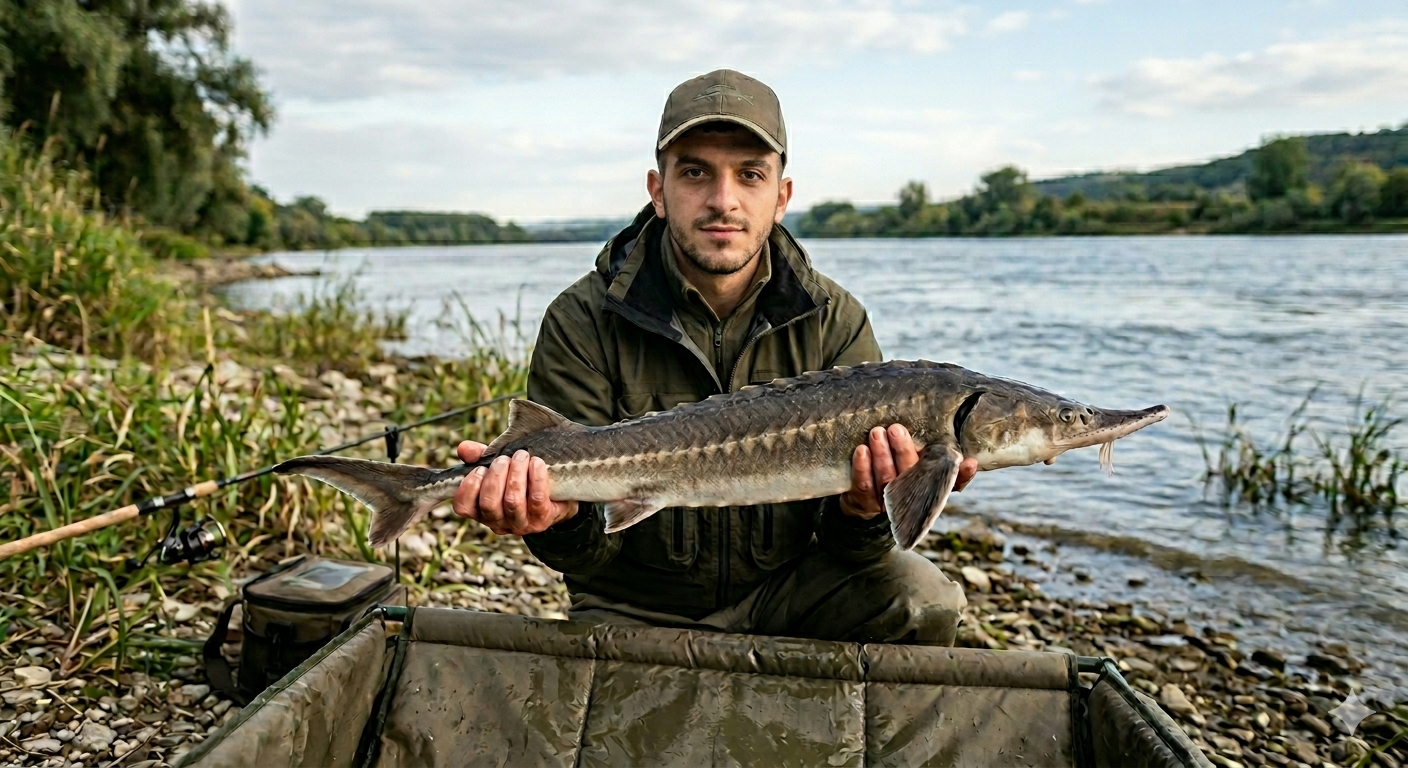
Photographing large specimens safely requires keeping the fish low to the unhooking mat and supporting its weight horizontally across both hands. The angler should kneel behind or over the wet unhooking cradle, never standing up while holding the fish, as a sudden slip or twist could cause the heavy specimen to fall several feet onto the ground. Slide one hand under the strong pectoral girdle just behind the gill covers to support the heavy head end, while placing the other hand securely under the rear body near the anal fin to support the tail section. Never lift the fish by its gills, barbels, or tail alone, and avoid squeezing its softer abdominal area where internal organs reside. Keep the camera operator ready beforehand so that photos can be snapped in rapid succession before guiding the fish immediately back into the water.
Safe Release and Recovery Protocols for the Sturgeon
Ensuring that a heavy, fully fought specimen recovers completely and swims away strongly is the final and most important responsibility of a conservation-minded angler. During prolonged battles, particularly in warm summer waters with low dissolved oxygen levels, these fish accumulate significant amounts of lactic acid in their muscular tissue, leaving them completely exhausted and vulnerable upon release. Simply tossing or dropping a tired fish back into deep water without proper rehabilitation can result in the specimen sinking to the bottom on its side and suffocating. Recovery protocols demand patience, physical support in oxygen-rich water, and careful observation until the fish regains its equilibrium, strength, and active swimming momentum.
Sturgeon need Oxygenating Before Release
Rehabilitating a tired fish requires holding it upright in deep, well-oxygenated water facing directly into the prevailing current or wave action. Gently submerge the fish until water covers its gills completely, supporting its belly with both hands while keeping its head turned into the current. This forward water alignment forces fresh, oxygen-saturated water through the mouth cavity and across the gill filaments, rapidly flushing out accumulated lactic acid and restoring oxygen levels in the bloodstream. If fishing in static lake waters, slowly moving the fish forward in gentle underwater strides creates artificial flow over the gills. Continue holding the fish steady until its body loses its limpness, its breathing movements normalize, and it begins to actively kick its strong tail against your hands.
Sturgeon Monitoring Swimming Recovery
The release is complete only when the fish demonstrates clear signs of self-sustained balance, strong muscular tone, and energetic swimming capability. Never release a specimen that leans to one side, remains immobile, or floats weakly near the surface. Hold the tail wrist firmly while supporting the belly until you feel the heavy lateral muscles flex powerfully, signaling that full motor control has returned. Once the fish forcefully pushes itself out of your hands and swims down toward the lakebed or river floor under its own power, observe its movement from the bank for a few minutes to confirm it settles cleanly on the bottom. Taking these extra minutes during the recovery phase ensures near-zero post-release mortality and preserves specimen populations for years to come.
Expert Angler Tips from Global Forums for the Sturgeon
Compiling hard-won wisdom from experienced specimen anglers across international fishing forums reveals invaluable tactical nuances that consistently turn difficult sessions into success. A recurring theme emphasized by top forum contributors is the necessity of extreme patience and minimal swim disturbance when targeting large, nomadic bottom-feeders. Expert anglers stress that over-baiting a swim with excessive loose offerings can often backfire, causing patrolling fish to fill up on freebies without ever touching the hookbait. Instead, deploying small, highly concentrated PVA bags or stringers directly attached to the hook rig delivers pinpoint attraction that draws instant inquiry without overfeeding the fish.
Baiting Strategy Insights for Sturgeon
Seasoned forum veterans consistently advise adopting a “little and often” baiting approach rather than dumping massive piles of pellets or boilies into a single spot at the start of a session. Introducing a handful of crushed halibut pellets and broken fishmeal boilies around the terminal rig every thirty to forty minutes keeps scent active in the water column while forcing searching fish to forage actively across the substrate. Furthermore, forum discussions frequently highlight the power of topping heavy fishmeal hookbaits with small, bright visual accents—such as a tiny artificial pink corn grain or a washed-out yellow pop-up topper—to create a subtle visual target that grabs the fish’s attention as its barbels sweep over dark mud or silt beds.
Rig Concealment Hacks for Sturgeon
Advanced forum threads dedicated to heavy bottom tactics frequently highlight the critical importance of total rig camouflage in clear or heavily pressured commercial fisheries. Experienced anglers advocate applying small lumps of tungsten putty at uniform intervals along the last six feet of the mainline above the lead assembly to pin the line perfectly flush against the lakebed contour. This prevents patrolling giants from bumping their sensitive fins or scutes against taut mainlines, which causes immediate panic and clears the swim. Additionally, tinting braided hooklinks with dark waterproof markers to blend seamlessly into local silt, gravel, or weed beds removes visual warnings, ensuring that cautious fish feed over the terminal presentation with complete, relaxed confidence.
Lunar Cycles and Weather Effects on the Sturgeon
Environmental variables, barometric pressure shifts, and lunar phases exert a profound influence on the movement, feeding activity, and metabolic drive of ancient benthic fish species. Many veteran anglers track atmospheric trends closely, knowing that sudden weather fronts often trigger intense feeding frenzies or shut down activity completely. Generally, low-pressure systems accompanied by mild, overcast conditions and warm southerly winds generate optimal feeding opportunities, as falling barometric pressure prompts bottom-dwelling species to search for food actively before arriving storms. Conversely, sharp high-pressure spikes accompanied by cold, clear blue skies typically cause fish to retreat into deep holding holes and become completely lethargic.
Moon Phases and Tidal Movement
The major lunar phases—specifically the Full Moon and New Moon—exert a powerful gravitational pull that heavily influences feeding windows in both tidal river estuaries and landlocked commercial waters. During the New Moon phase, when dark night skies combine with strong gravitational tides in coastal rivers, feeding activity often reaches its absolute seasonal peak. The increased water exchange during spring tides pushes abundant marine baitfish, crustaceans, and organic matter into estuarine channels, stimulating intense foraging routines among resident and migratory populations. Even in landlocked lakes, many specimen anglers record significantly higher catch rates during the three days leading up to and immediately following a Full Moon, noting that illuminated nighttime conditions encourage fish to cruise shallower gravel shelves in search of food.
Barometric Pressure Trends for Sturgeon
Stable or slowly falling barometric pressure readings ranging between 1008 hPa and 1014 hPa represent the ideal atmospheric sweet spot for targeting active bottom-feeders. When a warm low-pressure front approaches, dissolved oxygen dynamics shift and water turbidity often increases, creating a comfortable, low-light underwater environment where large fish feel secure leaving deep cover to forage. Conversely, a sudden dramatic rise in atmospheric pressure above 1025 hPa creates stable but bright conditions that frequently lock down feeding activity. During high-pressure spells, successful anglers adapt by casting into the deepest available river pools or shaded structures where thermal conditions remain stable, switching to highly concentrated liquid attractants to entice reluctant fish into taking a bait.
Seasonal Patterns and Water Temperature for the Sturgeon
Understanding how seasonal temperature swings affect the metabolic rate, movement, and nutritional requirements of these primitive creatures is essential for year-round angling success. As cold-blooded organisms, their internal body temperature and digestive efficiency are governed directly by the thermal state of their surrounding aquatic environment. During cold winter months, water temperatures dropping below 6°C (43°F) slow their digestion to a crawl, reducing feeding windows to brief, unpredictable intervals. As spring arrives and water temperatures warm past key biological thresholds, feeding activity explodes, reaching peak intensity during late spring and summer before tapering off again during the transition into autumn.
Sturgeon Spring and Summer Patterns
When spring water temperatures rise above 12°C (54°F), these hungry bottom-dwellers emerge from deep winter dormancy with an insatiable appetite, actively searching for high-protein food sources to rebuild depleted body mass. During this high-energy spring phase, they move out of deep winter pools and migrate toward shallower gravel flats, river margins, and flooded bays where natural food like spawning fish, worms, and larvae are abundant. By mid-summer, when water temperatures peak above 20°C (68°F) and surface dissolved oxygen levels drop, feeding shifts primarily toward cooler, well-oxygenated night windows or fast-flowing river tailwaters below dams and spillways where oxygen levels remain elevated.
The Sturgeon Autumn and Winter Transition
Autumn represents a prime feeding window as fish instinctively gorge on rich, fatty food sources to build up massive lipid reserves needed to survive the upcoming winter cold. During early autumn, when water temperatures sit comfortably between 14°C and 18°C (57°F to 64°F), heavy feeding activity occurs across all depths, making this one of the most productive times of the year for specimen hunting. However, as late autumn turns into winter and water temperatures plunge toward freezing, activity slows down significantly. Winter tactics require switching to minimal baiting strategies, using smaller, highly digestible hookbaits, and casting exclusively into deep, thermally stable holding pools where cold-water fish group together to conserve vital energy.

Culinary Preparation and Filleting of the Sturgeon
Preparing the firm, boneless meat of this ancient fish for high-end culinary applications requires specific knife skills and butchery techniques that differ significantly from handling standard teleost fish. Because these creatures possess a cartilaginous notochord instead of a hard bony skeleton, there are no fine floating pin bones to remove during filleting. However, the outer skin is extremely tough, thick, and covered with hard bony scutes that will instantly dull standard fillet knives if approached incorrectly. Utilizing a razor-sharp, heavy-duty stiff boning knife and a flexible filleting knife allows chefs to clean, skin, and portion the thick, muscular loin fillets cleanly and efficiently.
Sturgeon Skinning and Scute Removal
The first critical step in processing a whole dressed fish is trimming away the tough outer skin along with the heavy bony plates running along its back and sides. Place the dressed fish flat on a large, stable cutting board and use a heavy boning knife to slice off the hard dorsal scutes along the spine from tail to head. Next, lay the flexible filleting knife flat against the tail end of the fillet, gripping the skin tail-tab firmly with a dry towel or pliers. Angle the sharp blade slightly downward against the tough skin and use a smooth, sawing motion to slide the blade completely under the muscular loin, separating the dense white flesh cleanly from the skin in one continuous stroke without leaving valuable meat attached to the skin.
Trimming Dark Meat and Portioning
Once the clean fillet is free from the tough outer skin, you will notice a distinct band of dark, reddish lateral muscle running along the outer edge of the flesh. This dark muscular tissue contains high concentrations of oil and blood vessels, which can impart a strong, muddy, or metallic flavor to the finished dish if left intact. Use a flexible boning knife to carefully trim away all traces of this dark lateral meat until only pristine, firm, ivory-white flesh remains. Trim the thick, boneless loin into uniform steak portions measuring roughly one to one-and-a-half inches in thickness, ensuring that all cuts are uniform so they cook evenly during high-heat roasting, grilling, or searing processes.
Gourmet Recipe 1: Oven-Roasted Sturgeon Steaks
Oven-roasting thick cuts of this dense, firm-textured fish at precise high temperatures highlights its rich, veal-like texture while keeping the interior succulently moist and tender. Because the flesh is naturally robust and rich in healthy fats, it holds up magnificently to roasting alongside aromatic root vegetables, fresh Mediterranean herbs, garlic, and citrus glazes. Roasting the fish on a preheated baking sheet or inside a heavy cast-iron skillet creates a beautifully caramelized outer crust while locking in essential juices, producing an elegant restaurant-quality seafood centerpiece that satisfies even the most demanding gourmet palates.
Ingredients and Oven Temperature Setup
To prepare this savory gourmet roast for four portions, gather the following premium ingredients: four 250-gram boneless loin steaks (1.5 inches thick), 3 tablespoons of extra-virgin olive oil, 3 cloves of finely minced fresh garlic, 2 tablespoons of freshly chopped rosemary and thyme, 1 teaspoon of sea salt, 1/2 teaspoon of freshly cracked black pepper, 1 tablespoon of fresh lemon zest, and 100 ml of dry white wine (such as Pinot Grigio or Sauvignon Blanc). Preheat your convection oven precisely to **200°C (400°F)**, ensuring the baking rack is positioned in the center slot. Place a heavy-duty cast-iron skillet or enamel roasting pan inside the oven during preheating so the metal surface gets scorching hot before adding the fish.
Step-by-Step Cooking Instructions
Pat the boneless steaks completely dry using paper towels to ensure proper surface searing. In a small bowl, mix together the olive oil, minced garlic, chopped rosemary, thyme, lemon zest, sea salt, and cracked black pepper. Brush this aromatic herb mixture generously over all sides of the steaks. Carefully remove the preheated hot skillet from the **200°C (400°F)** oven, place it on the stove over medium-high heat, and sear the steaks for exactly **2 minutes per side** until a light golden crust forms. Pour the dry white wine around the base of the steaks into the hot pan, then transfer the skillet immediately back into the preheated oven. Bake at **200°C (400°F)** for exactly **12 to 14 minutes**, or until the internal temperature reaches **63°C (145°F)** on a digital meat thermometer. Remove from heat, tent loosely with foil, and let rest for 5 minutes before serving hot.

Gourmet Recipe 2: Pan-Seared Sturgeon in Lemon-Butter Sauce
Pan-searing delivers an incredible, crispy outer crust while transforming the interior meat into a velvety, melt-in-your-mouth delicacy. Combining the rich, buttery mouthfeel of the fish with a classic French Meunière-style sauce—featuring browned butter, tart lemon juice, capers, and fresh parsley—cuts through the natural richness of the protein, creating a perfectly balanced flavor profile. This quick, high-heat cooking method relies on precise pan temperature control and continuous basting with foaming butter to cook the steak evenly without drying out its delicate muscular fibers.
Ingredient Preparation
For this classic pan-seared dish serving two persons, assemble these fresh ingredients: two 200-gram skinless loin portions, 2 tablespoons of clarified butter (or high-heat avocado oil) for searing, 3 tablespoons of unsalted unsalted European-style butter, 1 tablespoon of nonpareil capers (rinsed and dried), 2 tablespoons of freshly squeezed lemon juice, 2 tablespoons of finely chopped flat-leaf parsley, sea salt, white pepper, and 2 tablespoons of fine all-purpose flour for light dusting. Ensure all fish portions are allowed to rest at room temperature for 15 minutes prior to cooking so the meat does not shock or cool down the hot pan surface during searing.
Searing Technique and Basting
Season the fish portions lightly with sea salt and white pepper, then dust them lightly with all-purpose flour, shaking off any excess coating. Heat a heavy stainless steel or cast-iron skillet over medium-high heat until hot, then add the 2 tablespoons of clarified butter. Once the butter shimmers and begins to smoke lightly, lay the seasoned portions gently into the pan away from you. Sear undisturbed for **4 to 5 minutes** until a deep golden-brown crust develops on the bottom. Flip the portions carefully using a wide spatula, then lower the heat to medium and add the 3 tablespoons of fresh unsalted butter, capers, and lemon juice directly to the pan. As the butter foams and browns, tilt the skillet slightly and use a large spoon to continuously baste the hot lemon-butter over the top of the fish for an additional **3 to 4 minutes**. Remove from the pan, sprinkle with fresh parsley, and serve immediately with pan juices spooned over the top.
Wine Pairing and Culinary Accompaniments for the Sturgeon
Sturgeon White and Sparkling Wine Pairings
Selecting the perfect wine to complement the dense texture and rich flavor profile of this gourmet fish requires balancing acidity, weight, and aromatic intensity. Because the meat possesses a rich mouthfeel similar to swordfish or veal, light, watery white wines will easily be overpowered by the dish. Full-bodied, barrel-aged White Burgundies (Chardonnay) featuring crisp acidity, subtle oak integration, and buttery vanilla notes pair exquisitely with oven-roasted or pan-seared dishes, matching the fat profile of the fish while cutting through rich butter sauces. Alternatively, dry high-acid white wines such as French Sancerre, German Dry Riesling (Trocken), or high-end Italian Pinot Grigio offer bright citrus minerals that cleanse the palate perfectly between bites of rich, oily fish fillet.
For celebrations featuring high-grade caviar appetizers preceding the main fish course, traditional vintage Champagnes or dry sparkling wines produced via the *Méthode Traditionnelle* serve as the ultimate pairing partner. The fine, persistent effervescence and sharp acidity of a Brut Champagne cut through the velvety, salty richness of authentic cured roe, scrubbing the palate and enhancing the delicate nutty notes of the caviar without overpowering the senses. Dry sparkling wines also pair surprisingly well with rich pan-seared or deep-fried fish preparations, providing a refreshing carbonated contrast that balances heavier culinary elements seamlessly.
Side Dishes and Flavor Profiles for Sturgeon
Designing sophisticated side dishes to accompany these dense fish portions requires selecting side elements that provide contrasting textures, bright acidity, or earthy grounding flavors. Creamy, buttery side dishes such as classic Yukon Gold potato purée, truffle-infused polenta, or parmesan risotto provide a luxurious base that cradles roasted loin portions beautifully. To balance this richness, incorporate bright, slightly acidic green vegetables such as charred asparagus spears tossed in lemon juice, sautéed baby spinach with minced garlic, or grilled artichoke hearts seasoned with sea salt and cracked black pepper.
Earthy root vegetables and roasted seasonal produce offer another exceptional accompaniment angle, particularly for rich autumn or winter presentations. Oven-roasted baby carrots glazed with honey and thyme, pan-roasted wild chanterelle mushrooms, or braised fennel bulbs complement the firm, meaty texture of the fish while adding complex savory-sweet aromas to the plate. Acidic sauces, such as a traditional French Beurre Blanc, a bright green salsa verde packed with fresh herbs and capers, or a light white wine and sorrel reduction, complete the meal by harmonizing all culinary elements into a memorable, high-end dining experience.