Northern Pike Power: Origin, Behavior, and Tactical Secrets for Landing the Best Ultimate Freshwater Predator 2026
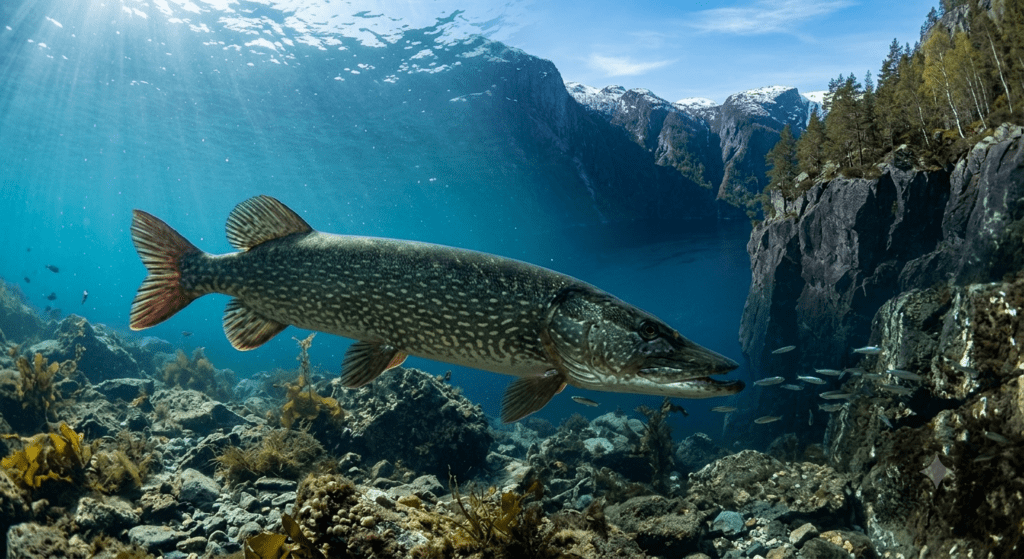
The Northern Pike (Esox lucius) is undoubtedly one of the most fascinating, aggressive, and highly sought-after freshwater game fish in the world. Its elongated, torpedo-like body, striking camouflage, explosive speed, and ferocious predatory strikes make targeting this species an unforgettable experience for anglers of all skill levels. Whether you are a beginner picking up your first lure rod or a seasoned angler looking to fine-tune your tactics, the pike always presents an exhilarating challenge on the water.
In this comprehensive guide, we will break down every single dimension of this apex predator’s life. You will discover where the northern pike originates, its biological and anatomical traits, the specific types of waters it inhabits, and how its behavior shifts between calm lakes and powerful, fast-flowing rivers. Furthermore, we will delve deeply into effective fishing techniques—including live baiting with floats and modern lure fishing methods—as well as the culinary value of its meat, legal regulations and closed seasons, and invaluable community tips to help you locate active pike and land the fish of a lifetime.
Where Northern Pike Originate: Evolutionary History and Global Range
The northern pike belongs to the family Esocidae, a ancient group of freshwater fishes built entirely around an ambush-predator lifestyle. The evolutionary history of the pike traces back to the cooler regions of the Northern Hemisphere, where the species adapted over millions of years through significant geological and climate shifts.
Evolutionary Development and Geographic Distribution
Fossil records reveal that early ancestors of the modern pike inhabited freshwater ecosystems as far back as the Eocene epoch. Thanks to its remarkable adaptability, efficient hydrodynamic design, and high tolerance for low temperatures, the northern pike expanded across vast territories, establishing stable wild populations throughout North America, Europe, and Northern Asia.
Today, the northern pike holds a circumpolar distribution across the Holarctic realm. From the icy lakes of Scandinavia and Siberia to the river systems of Western Europe and North America, its ability to thrive in oxygen-deprived or freezing waters has made it a dominant force in northern freshwater ecosystems.
Biological and Physical Characteristics of Northern Pike
Every aspect of the northern pike’s physical makeup is tailored for quick acceleration, stealth, and lethal efficiency. It operates as a true ambush predator, relying on camouflage and explosive bursts of speed rather than sustained long-distance chasing.
Body Shape and Hydrodynamic Anatomy of the Northern Pike
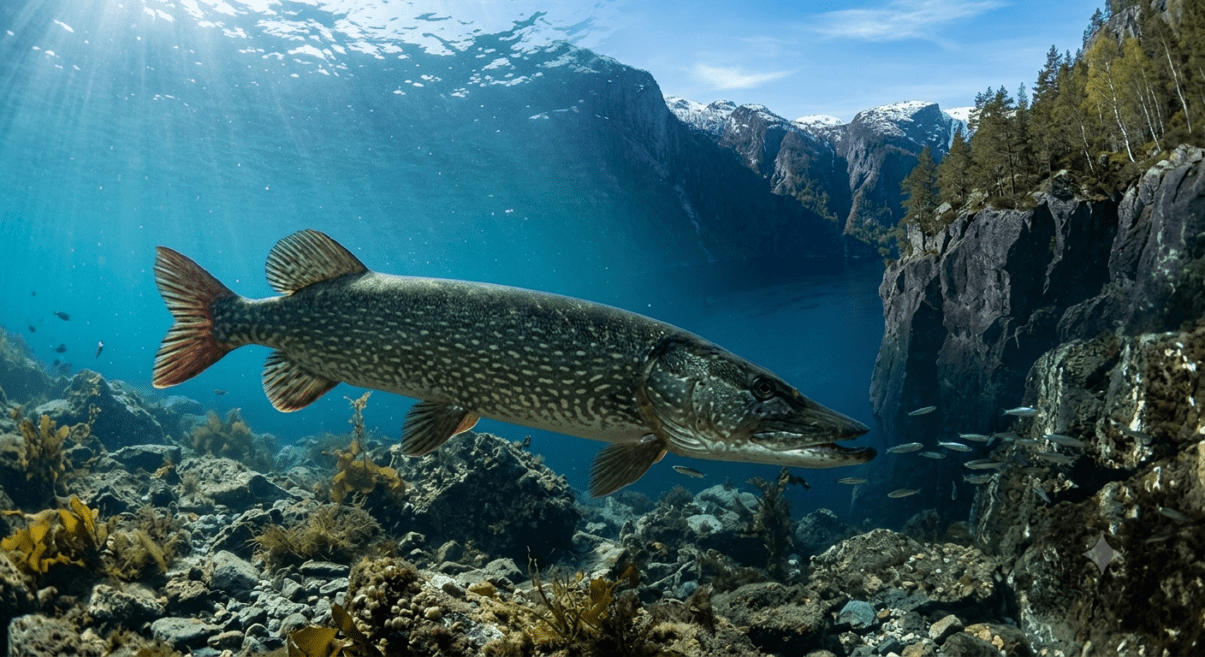
The body of a northern pike is long, slender, and laterally compressed. This streamlined shape minimizes water resistance during a strike. Uniquely, both the dorsal and anal fins are positioned far back on the body, right near the powerful caudal (tail) fin. This arrangement acts like a high-powered rear thruster, allowing the pike to launch itself forward from a standstill with astonishing force.
The Duck-Billed Head and Formidable Jaws
The head of a pike is large, flattened on top, and visually resembles a duck’s bill. However, inside its massive mouth lies one of the most formidable armaments in the freshwater world. The jaws are lined with hundreds of sharp teeth. The lower jaw features large, needle-sharp canine teeth designed to puncture and hold struggling prey, while the roof of the mouth (vomer and palatines) is covered in backward-slanting teeth that prevent prey from escaping down the throat.
Do Northern Pike Shed Their Teeth?
A common myth among anglers suggests that pike periodically shed all their teeth at once during certain months and cease feeding entirely. In reality, tooth replacement in northern pike occurs continuously and individually throughout the year. As old or damaged teeth fall out, new ones emerge to replace them, ensuring the predator is always ready to hunt.
Camouflage, Coloration, and Sensory Systems
Pike coloration varies slightly depending on the clarity and vegetation profile of its environment. Typically, the back ranges from dark olive-green to brownish-gray, shading into lighter green flanks patterned with yellowish or whitish spots and bar-like markings. This pattern breaks up the fish’s outline against submersed weeds and reed stalks. The belly is cream-colored or white, while the fins are reddish-yellow with dark transverse bands.
Northern Pike Visual Acuity and the Lateral Line System
Pike are visual hunters first and foremost. Their large eyes are mounted high on the head, providing a wide field of view and excellent binocular vision for judging distances above and in front of them. In addition to vision, the pike’s lateral line system is exceptionally sensitive, detecting minute pressure waves and low-frequency vibrations caused by struggling baitfish even in murky water or complete darkness.
Types of Waters Inhabited by Northern Pike
While northern pike are highly adaptable, they strongly prefer environments that offer abundant cover, structured bottoms, and plenty of forage fish. They thrive best in slow-flowing rivers, natural lakes, reservoirs, flooded gravel pits, and interconnected canal systems.
Water Quality and Environmental Tolerances
Although pike prefer clear water where they can utilize their keen eyesight, they can adapt to murky or stained waters by relying more heavily on their lateral line. They can tolerate a wide pH range and survive under winter ice conditions where oxygen levels drop, making them resilient inhabitants of diverse aquatic habitats.
Northern Pike Behavior in Still Waters and Lakes
In still waters—such as natural lakes, reservoirs, and ponds—pike establish clear behavioral patterns tied closely to water temperature, weed growth, and forage movements throughout the seasonal cycle.
Seasonal Movements in Lakes
- Spring: Following the early spring spawn, pike remain in shallow bays, flooded margins, and warming reed beds where baitfish gather to spawn.
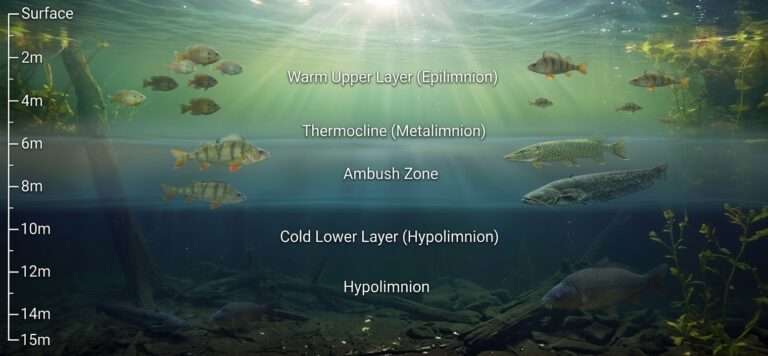
- Summer: As shallow waters warm up, larger trophy pike migrate toward deeper water drop-offs, thermoclines, or dense, cool weed beds, while smaller jack pike often stay in shorelines and lily pads.
- Autumn: Lowering water temperatures trigger intense feeding activity. Pike roam widely across lake basins and weed edges to build up fat reserves for winter.
- Winter: With aquatic vegetation dying back, pike descend to deeper basins, holding close to wintering schools of prey fish near the bottom.
Northern Pike Behavior in Fast and Large Rivers
Living in a river current requires significantly more energy than living in a lake. Because pike are built for short bursts of speed rather than continuous swimming against strong flows, their behavior in fast rivers revolves around energy conservation.
Energy Conservation and River Ambush Positions
In river systems, pike seek out slack-water micro-habitats immediately adjacent to main currents. They position themselves behind wing dams, bridge pilings, fallen trees, and inside deep eddies (limans). From these protected resting spots, they keep a watchful eye on the main current, waiting for injured or migrating baitfish to be swept past.
Where Northern Pike Hide in Lakes and Rivers
Finding pike consistently requires reading the water structure correctly. Look for key hiding spots depending on the environment:
Top Hiding Spots in Lakes and Ponds
- Reed and Cattail Margins: Shallow margins lined with thick reeds offer ideal cover for stalking shallow prey.
- Cabbage and Lily Pad Beds: Submerged weed beds provide vertical cover where pike can hide at various depths.
- Sunken Timber and Stumps: Hard structures in deeper water attract larger, solitary trophy fish.
- Drop-offs and Ledges: Sharp depth changes allow pike to hold in deep water and strike upward at passing targets.
Top Hiding Spots in Fast Rivers
- Eddies and Reverse Currents: Zones where the main current slows down or swirls backward.
- Behind Boulders and Wing Dams: Rock structures that break the river’s flow and create calm pockets.
- Inlets and Canal Junctions: Intersections where slow water meets river flow, bringing a steady supply of food.
- Undercut Banks with Overhanging Trees: Deep, shaded bank pockets filled with tangled roots.
Moon Phases and Solunar Influence on Pike Activity
Moon cycles have a noticeable impact on pike feeding windows. Many experienced anglers track solunar tables to identify peak activity times when pike actively hunt.
Solunar Periods
- Major Periods: Lasting 2 to 3 hours, these occur when the moon is directly overhead or directly underfoot. Pike frequently experience sudden feeding frenzies during these windows.
- Minor Periods: Lasting 1 to 1.5 hours, these correspond with moonrise and moonset times, offering additional high-percentage angling windows.
New Moon vs. Full Moon
During a New Moon, nights are dark, forcing prey fish to rest and making daytime lure feeding by pike highly effective. During a Full Moon, bright night conditions allow large pike to feed under moonlight; consequently, daytime activity may slow down, making early morning and twilight the most productive hours.
Tides as a Key Factor for Successful Northern Pike fishing
Although many anglers associate tides exclusively with saltwater fishing, these natural phenomena play an absolutely critical role in the behavior and feeding triggers of northern pike. The impact of gravitational forces from the Moon and Sun is felt not only in brackish waters, coastal bays, and estuaries where pike naturally thrive, but also in major inland river systems and tidal waterways where water levels rise and fall cyclically. Understanding these water movements often makes the difference between a fruitless day and catching the fish of a lifetime.
The incoming tide, or rising water, acts as the primary feeding trigger for pike. As the water level rises, fresh, oxygen-rich water floods into previously dry or shallow shoreline margins, carrying an abundance of microorganisms and nutrients. For baitfish, this is a clear signal to push into newly flooded vegetation and reed lines to feed. Pike, as supreme ambush predators, track these migrations flawlessly. They vacate their deep-water resting spots and take up strategic positions right along the edges of flooded cover, taking advantage of reduced visibility and moving water to launch lightning-fast attacks on disoriented prey.
Conversely, the outgoing tide and falling water phase demand a completely different approach from the angler. When the water begins to recede, pike do not retreat randomly. They methodically position themselves at the narrow exits of creeks, channels, and shallow bays, staging ambushes in deeper depressions and current seams. During these moments, the receding current funnels prey fish directly toward their waiting jaws. For anglers, this is the ideal time to present lures or live baits at choke points and depth transitions. By aligning your outings with tidal charts or water-level changes, you can predict with high accuracy exactly when pike will enter their most aggressive hunting windows.
Baits for Northern Pike: Float Fishing (Live Baiting)
Float fishing with live bait remains one of the most exciting and effective traditional techniques for targeting pike, especially when fish are sluggish or holding in specific cover.
Best Live Baits for Northern Pike
- Roach and Rudd: Flashy, silvery scales make them highly visible in all water conditions.
- Crucian Carp and Prussian Carp: Extremely hardy and active on the hook for long periods.
- Perch: A natural prey item; snipping the sharp dorsal fin spines beforehand is a common practice among pike anglers.
- Chub: Excellent hardy bait for river conditions.
Rigs and Terminal Tackle
Due to the pike’s razor-sharp teeth, using a wire trace (steel or titanium) or ultra-heavy fluorocarbon leader is mandatory. Standard monofilament or braid will be sliced instantly upon a strike. A typical float rig utilizes a large inline slider float (15g to 40g capacity) paired with a sliding sinker, buffer bead, quality swivel, and a trace equipped with single or treble hooks attached to the baitfish.
Baits for Northern Pike: Lure Fishing (Spinning and Jerking)
Lure fishing is an active, dynamic approach that allows anglers to cover large amounts of water efficiently and trigger reaction strikes.
Top Lure Categories
- Spoons: Classic metal spoons wobble and flash, mimicking a wounded baitfish. Excellent for searching open water.
- Inline Spinners: Large spinners produce heavy blade vibration that pike detect easily via their lateral line.
- Crankbaits and Minnows: Diving plugs allow precise depth control. Suspending models that pause in place frequently trigger follower strikes.
- Soft Plastics (Shads and Swimbaits): Versatile lures rigged on jig heads or offset hooks for fishing close to the bottom or inside heavy cover.
- Jerkbaits: Large, lipless glidebaits worked with sharp rod twitches to produce an erratic side-to-side darting action.
- Topwater Lures: Frog imitations and surface poppers provide explosive surface strikes during warm summer months.
Culinary Value and Flavor Profile of Pike Meat
Beyond its reputation as a hard-fighting game fish, the northern pike is highly regarded as a food fish in many traditional European culinary styles.
Meat Characteristics and Taste
Pike flesh is firm, white, and lean with an extremely low fat content. It offers a mild, clean, slightly sweet flavor that easily absorbs seasonings, marinades, and sauces.
Cooking Preparation and the “Y-Bones”
The primary challenge when preparing pike is its set of floating “Y-bones” running along the upper flank. To overcome this, chefs either fillet the fish using specific five-piece deboning techniques, score smaller fillets finely before pan-frying, or grind the meat to make gourmet fish cakes and quenelles. Larger pike fillets are excellent baked with vegetables, smoked, or cooked in rich fish stews.
Closed Seasons and Fishing Regulations
To protect pike populations and ensure successful natural reproduction, local fisheries authorities enforce closed seasons and size limits.
Spawning Period and Protection
Northern pike spawn very early in the year, often in late winter or early spring while water temperatures are still cold ($2^\circ\text{C}$ to $8^\circ\text{C}$). During the closed season (typically spanning from early February through April, depending on local jurisdiction), targeting or retaining pike is strictly prohibited. Any accidentally caught pike must be unhooked with extreme care and released immediately.
Size and Possession Limits
Anglers are required to adhere to minimum legal length limits (often starting around 40–50 cm) and daily bag limits set by local fishing permits. Returning larger breeding females (trophy fish over 80–100 cm) to the water is strongly encouraged to sustain healthy wild stocks.
Community Forum Advice: Practical Tips from Experienced Anglers
Experienced pike anglers across fishing forums consistently share practical observations that refine time-tested strategies:
Weather and Pressure Changes
Pike activity spikes sharply right before a approaching weather front or a sudden drop in barometric pressure. Overcast, drizzly, and windy days (“pike weather”) are historically far more productive than bright, calm, high-pressure conditions.
Essential Unhooking Tools
Always carry long-nosed pliers, wire cutters, and jaw spreaders. Pike engulf lures deeply, and trying to unhook a fish without long tools risks severe hand injuries from their razor-sharp teeth or loose treble hooks.
Why a Landing Net is Mandatory: The Sudden Near-Shore Run
One of the most frequent mistakes anglers make is assuming a pike is completely exhausted when it turns on its side and glides passively toward the bank or boat. When anglers think they have worn the fish out and can easily land it by hand, they are sorely mistaken. A northern pike has an incredible ability to save a final burst of explosive power specifically for that critical moment near the surface.
The instant it catches sight of the angler or feels a hand touching its body, panic sets in, triggering a violent, unpredictable dash back toward the deep water. This sudden headshake or surge often causes line breakage, hook pulls, or line severance against its sharp teeth, leaving the angler empty-handed in a fraction of a second. For this reason, using a large, rubberized landing net is the safest and most reliable method to land a pike, protecting both the angler from treble hooks and the fish from injury.
Summary
The northern pike remains a true icon of fresh waters. Understanding its evolutionary biology, seasonal movements, ambush preferences, tidal sensitivity, and feeding triggers equips any angler with the knowledge needed to pursue this formidable predator responsibly and successfully.
Fly Fishing for Pike and Budget-Friendly Lure Options
It is worth noting that in our previous articles, we covered the exciting topic of Pike Fly Fishing , where we detailed how using large streamer flies can be extraordinarily effective—especially in shallow waters, flooded weed beds, and during early spring when pike respond aggressively to slow-moving, high-profile fur and feather imitations.
Furthermore, as we highlighted in our dedicated guide on affordable pike lures, successful predator fishing does not require spending a fortune on high-end tackle. We explored where to find the most budget-friendly lures, highly accessible options, and cost-effective gear that deliver outstanding action in the water without breaking the bank. Combining these accessible lures with proper presentation techniques ensures that every angler can target trophy pike effectively on any budget.